
 Bernie Anabo Jr.
 A promotion controversy is brewing inside the Bureau of Customs (BOC), with questions being raised over the qualifications, technical competence, and alleged favoritism surrounding the elevation of certain personnel to higher positions.
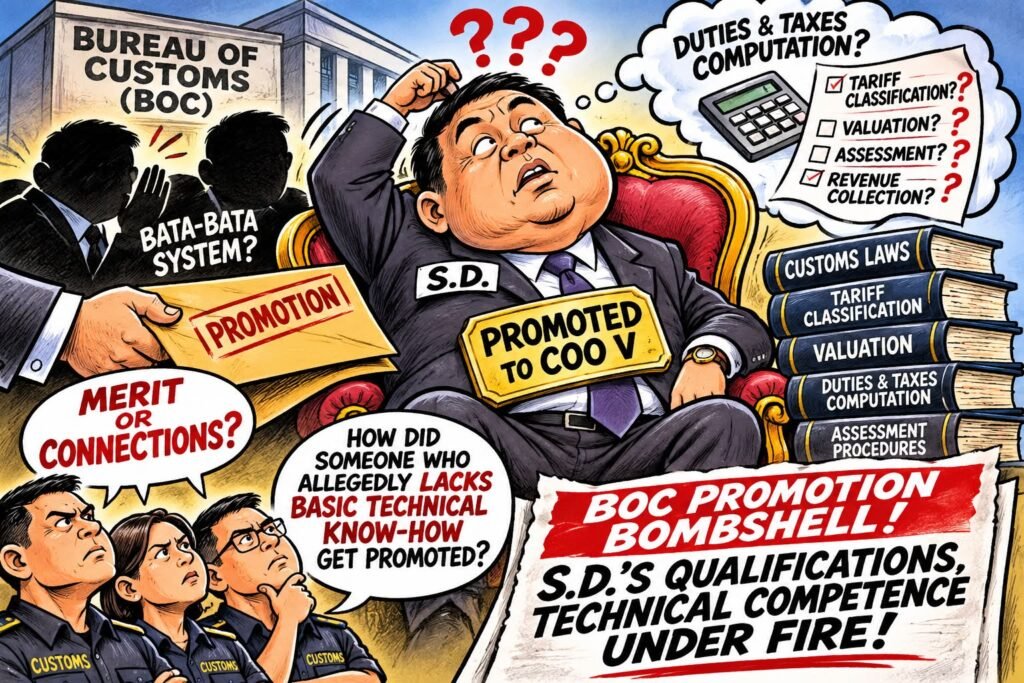
At the center of the growing controversy is a certain S.D., whose promotion is reportedly drawing scrutiny from insiders questioning whether the necessary technical knowledge, professional experience, and qualifications were sufficiently established before being elevated to a higher position.
The issue is putting the Bureau’s promotion system under the microscope.
Was the promotion based on merit, competence, and actual performance—or were other considerations allegedly at play?
PROMOTION WITHOUT COMPETENCE?
Customs is no ordinary government office. It is a critical revenue-generating agency responsible for assessing duties and taxes, enforcing customs laws, facilitating legitimate trade, and protecting the country against smuggling and illegal importation.
Technical knowledge is a basic requirement—not an optional qualification.
Questions are reportedly being raised about S.D.’s familiarity with fundamental Customs functions, particularly the computation of duties and taxes, an essential component of the Bureau’s operations.
If these questions are legitimate, they raise a troubling concern: how can personnel be entrusted with greater responsibilities if their mastery of the technical requirements of the job is being questioned?
For Customs employees who have spent years studying tariff classification, customs valuation, assessment procedures, revenue collection, and enforcement, promotions should represent professional achievement—not merely advancement in rank.
THE RETURN OF THE “BATA-BATA” SYSTEM?
The controversy has also revived concerns over the alleged bata-bata system—a practice in which connections and influential personalities are suspected of playing a role in personnel advancement.
Rumors of alleged favoritism have fueled questions about whether S.D.’s promotion was subjected to a fair, objective, and transparent evaluation.
Were all qualifications properly examined?
Was technical competence given sufficient weight?
Were other qualified and experienced personnel considered on equal footing?
The Bureau must ensure that promotions are not clouded by suspicions of preferential treatment. Every employee deserves a system where hard work, integrity, experience, and competence count more than connections.
QUALIFICATIONS MUST SPEAK LOUDER THAN CONNECTIONS
The promotion of personnel to higher positions carries greater responsibility, particularly in an agency where decisions can affect government revenues, importation procedures, enforcement operations, and the country’s economic interests.
A questionable promotion, if proven to have bypassed established standards, could undermine the morale of competent and dedicated Customs personnel who have spent years building their expertise.
The Bureau cannot afford a system where technical competence is questioned while advancement continues without clear and convincing justification.
A position is not simply a title. It is a responsibility that demands knowledge, accountability, and the ability to perform.
CUSTOMS NEEDS PROFESSIONALS, NOT FAVORITISM!
The Bureau of Customs must remain an institution where qualifications are respected and promotions are earned.
If S.D. is fully qualified and technically competent, the personnel records, credentials, performance evaluations, and accomplishments should establish that beyond question.
But if legitimate concerns exist regarding the promotion process, the Bureau must not ignore them.
Transparency is the best antidote to rumors. Fair evaluation is the best defense against allegations of favoritism. And competence must remain the foundation of every appointment and promotion.
THE BOTTOM LINE
The growing questions surrounding S.D.’s promotion should serve as a wake-up call for the Bureau of Customs.
Customs needs qualified leaders and competent personnel—not promotions clouded by allegations and doubts.
The new leadership must ensure that every promotion is defensible, every qualification verified, and every employee given a fair opportunity to advance.
IN CUSTOMS, PROMOTION MUST BE EARNED—not handed out through connections, favoritism, or the alleged “bata-bata” system.
The integrity of the Bureau demands nothing less.