
 Bernie Anabo Jr.
The Bureau of Customs is turning the heat up on reforms—and Assistant Commissioner Atty. Vincent “Jet” Maronilla is emerging as one of the key figures driving the agency’s push to make Customs faster, cleaner and more business-friendly.
Under the leadership of Commissioner Ariel F. Nepomuceno, the BOC, through the Post Clearance Audit Group (PCAG) headed by Maronilla, took another major step toward dismantling red tape with a stakeholder forum on the policies, procedures and reforms of the Accounts Management Office (AMO) held on July 28, 2026.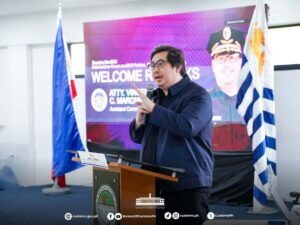
The message from Maronilla and the PCAG was blunt: Customs accreditation should no longer be a bureaucratic obstacle course.
Following the transfer of the AMO to PCAG, major changes are now being pushed to streamline the accreditation of importers and customs brokers.
Among the reforms: accreditation validity extended from one year to three years, the elimination of pre-checking, and faster processing targeted at just three to seven working days.
For compliant and qualified stakeholders, the reforms mean less waiting, fewer bureaucratic layers and more predictable transactions.
The BOC also laid out an automatic renewal system for eligible importers, a move designed to eliminate unnecessary repeat transactions and allow Customs personnel to focus more aggressively on compliance, enforcement and post-clearance verification.
JET MARONILLA: REFORM WITH TEETH
But Maronilla’s reform agenda is not simply about making Customs faster.
It is about making the system smarter and more accountable.
The transfer of AMO to PCAG places accreditation within a structure more closely connected to post-clearance audit and compliance—sending a clear signal that ease of doing business and strict enforcement can go hand in hand.
The objective is straightforward: reward compliant stakeholders with faster service while keeping Customs’ eyes firmly trained on those who violate the rules.
During the forum, stakeholders were given the opportunity to raise operational concerns, clarify accreditation requirements and question procedures directly.
That open dialogue matters.
A modern Customs bureau cannot operate behind closed doors. Rules must be clear, procedures must be predictable, and legitimate businesses must know exactly what is expected of them.
NO MORE RED TAPE?
The reforms now being pursued under Maronilla’s watch could mark a significant shift in the way importers and customs brokers deal with the BOC.
Three years instead of one.
No more pre-checking.
Three to seven working days for processing.
Automatic renewal for qualified importers.
These are not cosmetic changes. They strike directly at the delays, paperwork and uncertainty that have long frustrated legitimate stakeholders.
But the real test is implementation.
The reforms must be felt not only in policy papers and stakeholder forums, but at the counters, offices and transactions where importers and brokers actually do business.
That is where Maronilla’s leadership will be measured.
REFORM, BUT NO FREE PASS
And there should be no misunderstanding.
Ease of doing business does not mean ease of breaking the law.
The BOC’s modernization push must continue to make life easier for compliant traders while making it increasingly difficult for smugglers, fraudulent importers and other violators to exploit the system.
That is where the PCAG becomes critical.
With Maronilla at the helm, the message is becoming increasingly clear:
Simplify the process. Speed up legitimate transactions. Strengthen compliance. And go after those who abuse the system.
For Customs stakeholders, the direction is unmistakable.
Less red tape. More accountability. Faster service. Stronger enforcement.
And if the reforms are implemented with the same urgency with which they are being pushed, Atty. Jet Maronilla may well become one of the most consequential figures in the BOC’s ongoing transformation.