 Dr. Bernie Anabo Jr

A powerful customs-corporate alliance is taking center stage at the Port of Clark as District Collector Jairus S. Reyes welcomed newly appointed FedEx Philippines Managing Director Garrick Thompson, signaling renewed efforts to strengthen cargo operations, accelerate customs clearance, and push trade facilitation into high gear.
Thompson, who assumed his new post in September 2026, paid a courtesy visit to Collector Reyes, accompanied by former FedEx Philippines Managing Director Maribeth E. Espinosa.
But beyond the pleasantries and handshakes, the meeting underscored a critical mission: keeping shipments moving, customs procedures efficient, and Clark International Airport competitive in the country’s fast-moving logistics and international trade sectors.
REYES: EFFICIENT CUSTOMS, STRONGER TRADE!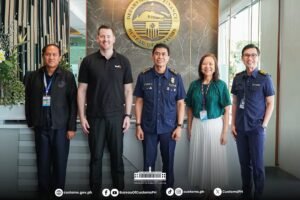
Collector Reyes is putting the spotlight on operational efficiency and closer coordination with major logistics players, recognizing that every delay in cargo clearance can affect businesses, supply chains, and the movement of goods.
Under his leadership at the Port of Clark, the challenge is clear: maintain effective customs controls while ensuring legitimate shipments move through the system with speed, transparency, and accountability.
For Reyes, trade facilitation is not merely a slogan. It requires responsive service, streamlined procedures, and sustained cooperation between Customs and the private sector.
The Port’s commitment to supporting FedEx operations reflects the importance of striking the right balance between enforcement and efficiency—protecting government revenues while helping legitimate commerce thrive.
THOMPSON TAKES THE HELM AT FEDEX PHILIPPINES!
For newly appointed Managing Director Garrick Thompson, the courtesy visit marks an opportunity to reinforce FedEx’s working relationship with the Port of Clark and strengthen coordination with the customs authorities responsible for processing its shipments.
FedEx, a major player in international express transportation and logistics, depends on efficient customs procedures to keep cargo moving across borders and deliver reliable service to businesses and customers.
Thompson’s new leadership comes at a time when speed, reliability, and seamless cross-border movement remain critical to the logistics industry.
The message is unmistakable: closer coordination between FedEx and the Bureau of Customs can help minimize unnecessary delays, improve operational efficiency, and support the growing demands of international trade.
NO ROOM FOR RED TAPE—TRADE MUST MOVE!
The Reyes-Thompson engagement highlights a broader challenge facing Philippine customs operations: how to deliver faster cargo processing without compromising border security, regulatory compliance, or revenue protection.
For importers, exporters, and logistics operators, efficient clearance means more predictable transactions and fewer disruptions. For the government, effective coordination can help improve compliance and sustain legitimate trade.
The meeting also acknowledged the continuity of the partnership, with former Managing Director Espinosa joining Thompson during the courtesy call.
While the visit does not itself establish new policies or specific operational targets, it sends a clear signal that dialogue between Customs and the logistics industry remains essential.
THE BOTTOM LINE
With Jairus S. Reyes steering the Port of Clark’s customs operations and Garrick Thompson taking charge of FedEx Philippines, the stage is set for stronger institutional coordination and a renewed push for efficient cargo movement.
The real test, however, lies beyond courtesy calls and official photographs. Businesses will ultimately judge the partnership by results: faster legitimate cargo clearance, transparent procedures, reliable service, and uncompromising enforcement against unlawful shipments.
REYES AND THOMPSON NOW HAVE A COMMON MISSION: KEEP CLARK MOVING, CUT UNNECESSARY DELAYS, AND MAKE TRADE FACILITATION WORK!
Bernie
INSIGHT
By: Dr. Bernie Anabo Jr
WHEN TAX ADVOCACY BECOMES A QUESTION OF PRIVATE INFLUENCE
Mon Abrea, the Business of Tax Reform, and the Boundaries of Professional Authority
There is a profound difference between challenging an institution to become better and behaving as though one possesses the moral authority to dictate how that institution should operate.
One is legitimate advocacy. The other, when accompanied by improper interference, becomes a threat to institutional independence.
This distinction deserves serious examination in the case of Raymond “Mon” Abrea.
Over the years, Abrea has cultivated a public identity as a tax reform advocate, frequently presenting himself as a global tax policy expert and a champion of taxpayers’ rights. His criticisms of the Bureau of Internal Revenue have contributed to public discussions about corruption, transparency, and accountability.
But there is another dimension to his public advocacy that must not escape scrutiny.
Mon Abrea is not merely a commentator on taxation. He is also a businessman whose consulting firm earns its living from providing professional tax advisory services.
There is nothing inherently improper about this arrangement. Tax consultants have every right to represent clients, challenge assessments, criticize government policies, and propose reforms.
Nevertheless, when public advocacy and private commercial interests intersect, legitimate questions arise.
Where does genuine reform advocacy end and commercial self-interest begin?
Could public criticism of tax administration also enhance the commercial visibility of a consulting firm? Could an individual’s reputation as a leading critic of the revenue system strengthen his influence when representing private clients before that same institution?
These are questions about professional incentives—not conclusions about personal wrongdoing.
More fundamentally, what happens when a private tax consultant attempts to cross the boundary between representing a taxpayer and exercising authority reserved by law to government?
The distinction is fundamental.
A tax consultant may dispute an assessment, challenge an examiner’s computations, negotiate within legally prescribed procedures, and exhaust available administrative and judicial remedies.
But no private consultant possesses the legal authority to dictate the amount of a government tax assessment or compel a revenue officer to adopt a particular conclusion through intimidation or threats.
If credible evidence establishes that any consultant has attempted such conduct, the matter should be investigated impartially, regardless of the person’s reputation, credentials, or public influence.
The same principle must apply to Mon Abrea as it does to every other professional.
And this leads to a larger question about the increasingly visible culture of public criticism.
Does the loudest critic necessarily possess the strongest moral authority?
Not always.
Expertise does not confer infallibility. International exposure does not confer governmental authority. And the ability to criticize public institutions does not automatically place the critic beyond legitimate questioning.
The designation global tax policy expert, however impressive, must ultimately be measured against substantive contributions, professional conduct, intellectual independence, and adherence to the very standards of accountability being demanded of government.
No academic qualification, international engagement, or professional distinction should become a substitute for these standards.
Nor should criticism of the BIR be dismissed merely because it comes from someone engaged in private practice.
Indeed, the Bureau must remain open to legitimate criticism. Honest taxpayers deserve fair assessments, competent examiners deserve institutional protection, and legitimate grievances must receive impartial consideration.
But accountability cannot be a one-way street.
Those who demand transparency from government should demonstrate comparable transparency concerning their professional interests and the boundaries separating their public advocacy from their private engagements.
Those who denounce abuse of authority must themselves respect lawful authority.
And those who speak repeatedly in the name of taxpayers should be prepared to explain how their advocacy remains independent of the commercial interests they represent.
Tax reform must never become a contest over who can claim the moral high ground.
Its true purpose is to build a revenue system governed by law rather than personality, evidence rather than pressure, and public interest rather than private influence.
Mon Abrea has every right to advocate reform. He also carries the responsibility, shared by all influential professionals, to ensure that advocacy does not become a claim to powers he does not possess.
Ultimately, the question is not whether Mon Abrea has earned the right to call himself an expert.
The more consequential question is whether every exercise of his professional influence reflects the same fairness, transparency, restraint, and accountability he demands from the Bureau of Internal Revenue.
For no one—neither a government official nor a self-described reform advocate—should stand above the principles he publicly champions.
True integrity is not established by how fiercely one condemns the system. It is demonstrated by how faithfully one observes the rules, especially when those rules limit one’s own influence.

 Morning Standard News Team