
 Morning Standard News Team
The message is loud and clear: NO MORE GUESSWORK, NO MORE CONFUSION—PUT THE WITHHOLDING TAX WHERE TAXPAYERS CAN SEE IT!
In a decisive move to strengthen transparency in tax transactions, the Bureau of Internal Revenue (BIR) has issued Revenue Regulations (RR) No. 6-2026, requiring creditable withholding tax, when applicable, to be separately indicated on invoices.
The new regulation, signed by Finance Secretary Frederick D. Go and published by the BIR on October 1, 2026, amends the mandatory invoice information under RR No. 7-2024, pursuant to the Ease of Paying Taxes Act.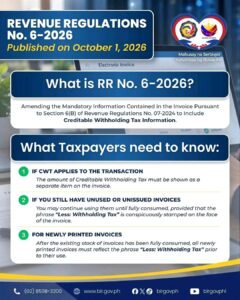
This is more than an invoice adjustment. It is a push for clearer documentation, better accountability, and fewer opportunities for confusion over money withheld in business transactions.
DOF Secretary Frederick Go deserves recognition for backing a measure that puts transparency at the center of tax administration. When taxpayers are expected to comply with the law, the rules governing their transactions must also be clear, understandable, and consistently implemented.
The principle is straightforward: every peso withheld must be properly documented, and both parties must have a clear record of the transaction.
GO: TRANSPARENCY MUST START WITH THE PAPER TRAIL!
A tax system cannot demand accountability from taxpayers while leaving them struggling to reconcile transaction records.
By requiring the withholding tax amount to appear as a separate invoice item, the regulation strengthens the paper trail between buyers and sellers. It gives businesses a clearer basis for checking deductions, reconciling payments, and verifying the amounts reflected in their records.
For Secretary Go, the challenge is to ensure that tax policy translates into practical improvements for the business community—not merely additional words in a regulation.
Clear rules. Clear invoices. Clear accountability.
That is the standard taxpayers should expect.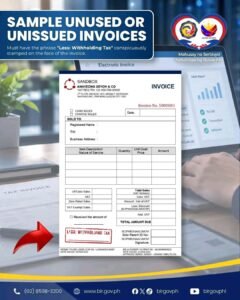
MENDOZA: MAKE EVERY WITHHELD PESO VISIBLE!
BIR Commissioner Atty. Charlito Martin R. Mendoza is putting the spotlight on a basic but crucial principle of tax compliance: taxpayers should be able to see what is being withheld and verify how that amount is reflected in the invoice.
“Taxpayers should be able to see what is being withheld from a transaction and how that amount is reflected in the invoice. Proper documentation reduces confusion, makes withholding easier to verify, and helps both parties comply correctly,” Mendoza said.
The Commissioner’s position hits the heart of the issue.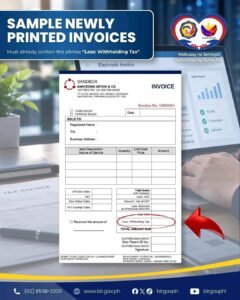
When withholding tax is properly identified, both parties have a clearer record to examine. Businesses can better reconcile their transactions, while documentation becomes easier to verify when questions arise.
Transparency is not a favor to taxpayers. It is a necessary element of responsible tax administration.
Mendoza’s challenge is to make sure the regulation is clearly communicated and consistently understood, especially by businesses that must adjust their invoicing practices to comply with the new requirements.
Because even the best-written regulation will fall short if taxpayers do not understand how to implement it.
OLD INVOICES? USE THEM—BUT FOLLOW THE RULE!
The BIR has also provided a practical transition measure.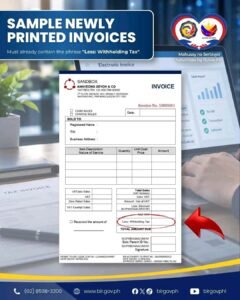
Taxpayers may continue using their existing unused or unissued invoices until fully consumed, provided that the phrase “Less: Withholding Tax” is conspicuously stamped on the face of the invoice.
Newly printed invoices must likewise carry the same phrase before they are used.
This provision matters. It gives businesses a way to use their remaining invoice supplies while complying with the updated documentation requirements.
But taxpayers must pay attention: the transition allowance is not permission to ignore the rule. The required phrase must be clearly displayed, and businesses should ensure that their invoicing practices conform to RR No. 6-2026.
The BIR, for its part, must communicate the requirements plainly to avoid unnecessary confusion, particularly among small and medium-sized enterprises that may have limited administrative resources.
THE REAL TEST: TRANSPARENCY THAT WORKS!
Let us be blunt: issuing regulations is only the opening salvo. The real test comes when the rules reach accounting offices, commercial establishments, suppliers, service providers, and ordinary business transactions.
Will taxpayers understand the requirement? Will invoices consistently reflect withholding tax when applicable? Will the documentation make verification easier? Will implementation reduce disputes instead of creating new layers of confusion?
These are the questions that will determine whether the regulation delivers its intended benefits.
Secretary Go and Commissioner Mendoza now have an opportunity to demonstrate that tax modernization is not just about collecting revenue. It is also about making compliance clearer, records more reliable, and the obligations of both parties easier to verify.
The government has a legitimate interest in collecting the correct taxes. Taxpayers, in turn, have a legitimate interest in accurate documentation and understandable rules.
Both interests are served when every transaction leaves a clear and verifiable paper trail.
Edited
THE BOTTOM LINE
RR No. 6-2026 may deal with a single line on an invoice, but that line carries an important message: withholding tax must not be left to assumptions when it can be properly documented.
Frederick Go’s role in the issuance of the regulation and Charlito Martin Mendoza’s emphasis on transparent withholding documentation put the spotlight on a practical reform in tax administration.
Now comes the harder part—implementation, taxpayer education, and consistent compliance.
Because in the business of taxation, clarity is not a luxury.
Accountability is not optional.
And transparency must be visible—not merely promised.
ONE INVOICE. ONE CLEAR RECORD. EVERY PESO PROPERLY ACCOUNTED FOR.
That is the kind of tax transparency taxpayers deserve and responsible public administration must deliver.


 Bernie Anabo Jr.