 Dr. Bernie Anabo Jimmy Saberon
MANILA — A sweeping tax modernization offensive is underway at the Bureau of Internal Revenue (BIR), with Commissioner Atty. Charlito Martin R. Mendoza pushing aggressive institutional reforms aimed at crushing outdated practices, tightening accountability, protecting government revenues, and delivering faster, more efficient services to Filipino taxpayers.
At the 5th SGV Tax Symposium 2026 in Makati City on October 19, Mendoza laid down the BIR’s reform battle plan under its D.A.R.E.S. agenda—a five-point strategy designed to overhaul the country’s tax administration system and make the agency more responsive, transparent, and accountable.
The message from the BIR chief was unmistakable: the days of tolerating old, inefficient practices must come to an end.
Under his leadership, the Bureau is pursuing five major priorities: Digital and Data Transformation; Audit Reform and Accountability; Revenue Collection and Revenue Base Protection; Employee Empowerment and Welfare Promotion; and Service Excellence and Stakeholder Engagement.
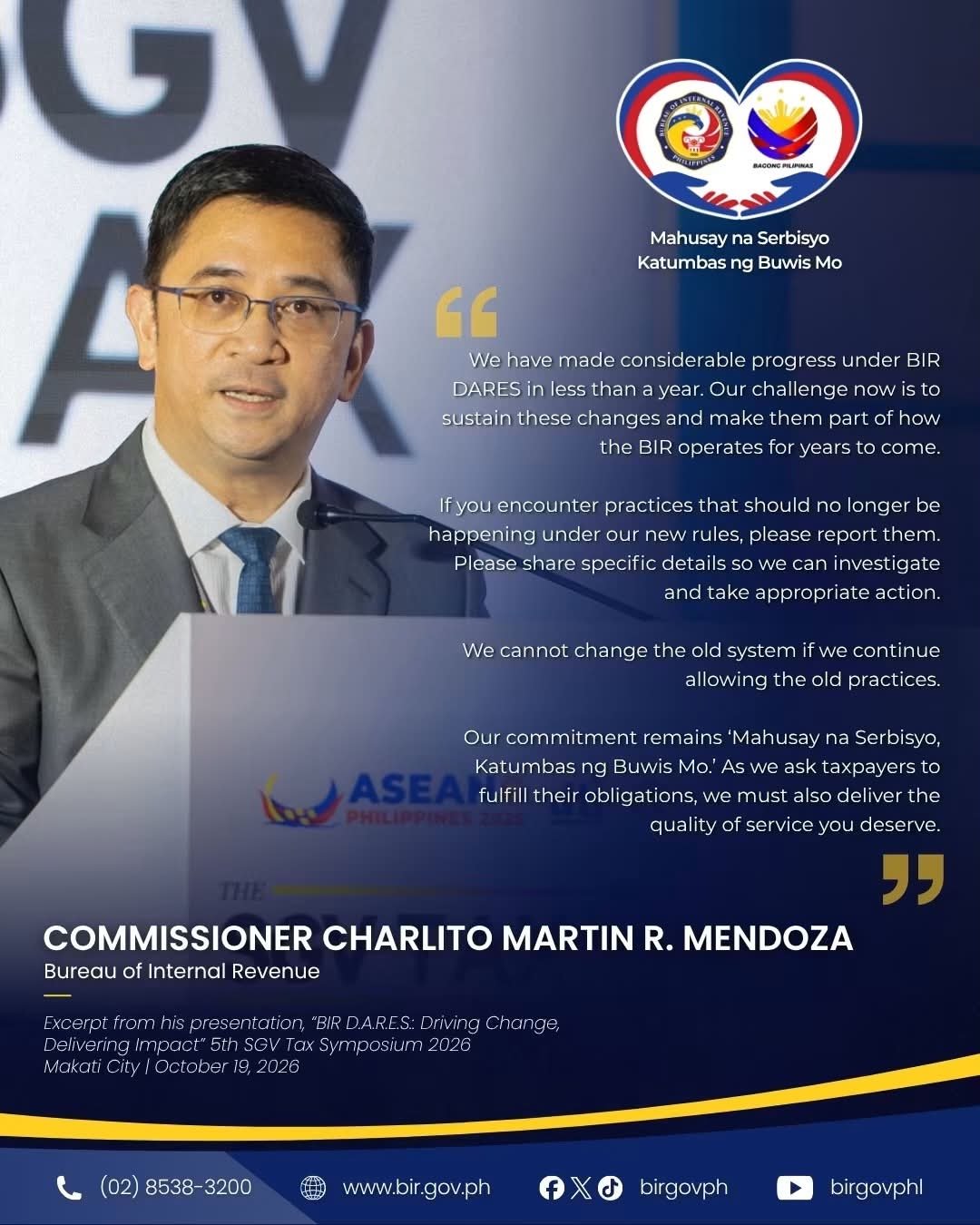
“We have made considerable progress under BIR DARES in less than a year. Our challenge now is to sustain these changes and make them part of how the BIR operates for years to come,” Mendoza declared.
NO MORE OLD-SCHOOL TAX SYSTEM!
Mendoza is betting heavily on digital transformation to modernize tax administration and eliminate unnecessary bureaucratic hurdles.
Among the key initiatives are the Digital TIN ID available through the eGovPH app, simplified eBIRForms for micro and small taxpayers, and the phased implementation of the Taxpayer Portal, initially targeting large taxpayers.
The BIR is also moving forward with electronic invoicing and the accreditation of Electronic Invoicing Service Providers (ESPs)—measures expected to streamline tax reporting, strengthen audit verification, and speed up the processing of tax refunds.
At the center of this digital offensive is BIR NEXT GEN, an ambitious vision for an integrated digital ecosystem that will connect taxpayer services and internal BIR operations through a reliable source of taxpayer information.
The Bureau is cleaning up taxpayer records, correcting inconsistencies, and working to retire outdated legacy systems that could obstruct modernization.
Mendoza’s technology push also includes TERRY, an AI-powered tax assistant intended to support tax research and verification, as well as the integration of the electronic Authority to Release Imported Goods (eATRIG) into the National Single Window.
The objective is clear: a more modern BIR capable of processing information efficiently, strengthening compliance, and protecting government revenues.
AUDIT ABUSES IN THE CROSSHAIRS!
Perhaps the most consequential component of Mendoza’s reform drive is the crackdown on improper audit practices.
The BIR has introduced the Single-Instance Audit, which limits audits to one Letter of Authority per taxpayer per taxable year, subject to applicable rules and exceptions.
Audit procedures are also being standardized under the Consolidated Audit Program and Manual, while the Revalida, or Audit of Auditors, is designed to reinforce accountability and ensure that revenue personnel follow established procedures.
Mendoza is also calling on taxpayers to report questionable practices and provide specific information that investigators can examine.
“If you encounter practices that should no longer be happening under our new rules, please report them. Please share specific details so we can investigate and take appropriate action,” the Commissioner urged.
His warning was even more direct:
“We cannot change the old system if we continue allowing the old practices.”
The statement sends a strong message that reform cannot succeed if the very people tasked with enforcing tax laws refuse to abandon improper practices.
While the BIR has not declared every reported irregularity proven, Mendoza’s call for specific complaints puts accountability and enforcement at the center of the agency’s modernization campaign.
ETHICS, DISCIPLINE AND REVENUE PROTECTION
The BIR chief is also strengthening the ethical foundation of the agency through ESACOR, an ethics course for BIR employees intended to promote professionalism and integrity.
At the same time, the Bureau is expanding consultations with business chambers, professional organizations, and industry groups through the Partnership with Multisectoral Group (PMSG).
These consultations are intended to help identify implementation problems, improve audit reforms, and prepare businesses for the transition to electronic invoicing.
The challenge is enormous: modernizing a nationwide tax administration system requires not only new technology but also disciplined personnel, consistent enforcement, reliable data, and public confidence.
For Mendoza, digitalization must go hand in hand with accountability. Better systems mean little if taxpayers continue to face unnecessary delays, inconsistent procedures, or questionable treatment.
DARES: NOT JUST A SLOGAN!
To prevent the reform drive from becoming another short-lived government initiative, the BIR has incorporated DARES into its Strategic Plan for 2026–2028.
The agency is cascading its priorities to Revenue Regions, Revenue District Offices, and other units, with defined programs, responsibilities, and performance measures.
This institutional approach is intended to ensure that modernization continues beyond individual projects and becomes part of the Bureau’s everyday operations.
The ultimate test, however, will be implementation: whether taxpayers experience faster transactions, whether audits become more predictable and accountable, whether compliance improves, and whether government revenues are protected without imposing unnecessary burdens on legitimate businesses.
Mendoza reaffirmed that the BIR’s modernization agenda must deliver tangible benefits to the public.
“Our commitment remains ‘Mahusay na Serbisyo, Katumbas ng Buwis Mo.’ As we ask taxpayers to fulfill their obligations, we must also deliver the quality of service you deserve,” he said.
For taxpayers who faithfully pay what they owe, the demand is straightforward: if the government expects compliance from the public, the BIR must deliver fairness, efficiency, integrity, and accountability in return.
Under Mendoza’s DARES agenda, the battle lines are drawn. The real measure of success will not be the number of programs announced, but the reforms taxpayers actually feel—and the accountability the Bureau is prepared to enforce.