 Bernie Anabo Jr.
This is what functional government looks like.
While complaints about red tape and inefficiency are easy currency, the Port of NAIA just shattered the lazy narrative — and Wärtsilä Philippines Inc. put it in writing.
In a formal letter dated October 31, 2025, Wärtsilä didn’t hedge. It didn’t dilute praise. It called out excellence by name, and the message was unmistakable: when leadership is firm, and systems work, results follow — fast.
At the top of that chain of command is Department of Finance Secretary Frederick D. Go, whose push for discipline and accountability continues to translate into real-world outcomes. Under his watch, agencies don’t just talk reform — they execute.
And executing front and center is Customs Commissioner Ariel F. Nepomuceno, whose leadership is increasingly being felt where it matters most: on the ground, at the ports, in the clearance lanes. The NAIA operation he oversees didn’t just process documents — it moved a critical national energy project forward.
Wärtsilä singled out District Collector Atty. Maria Yasmin M. Obillios-Mapa, whose leadership at the Port of NAIA turned what could have been a bureaucratic chokepoint into a model of speed and coordination. No drama. No delays. Just work done right.
Equally decisive was Special Deputy Collector Dr. Siegfried L. Manaois, leading the Pair Cargo Assessment Composite Division — a unit that proved efficiency isn’t about shortcuts, but about competence. His team delivered clearance with precision, ensuring that time-sensitive equipment reached Puerto Princesa, Palawan, without disruption.
Why does this matter?
Because the cargo involved wasn’t luxury goods or private indulgence. It was critical equipment for the repair of a damaged engine, part of an ongoing power project with Delta P., Inc. and its parent firm, Vivant Corporation — infrastructure that keeps the lights on for local communities.
That’s the bottom line.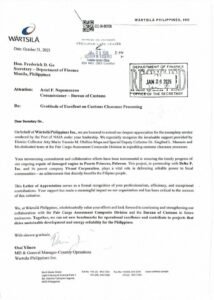
Customs efficiency here didn’t just help a company. It protected energy reliability, supported local economies, and delivered tangible benefits to Filipino consumers.
Wärtsilä’s letter wasn’t ceremonial. It was a scorecard — and this team passed with authority.
In an era where public trust is fragile, performances like this reset expectations. They prove that when leadership is clear, coordination is tight, and accountability is enforced, government can be a force multiplier — not an obstacle.
This is how benchmarks are set.
This is how credibility is rebuilt.
And this is how Customs earns respect — not by slogans, but by results.