 Bernie Anabo Jr.
No slowdown. No backsliding. No excuses.
As 2026 rolls in, the Bureau of Customs (BOC) is making one thing clear: good governance reforms are not a one-year experiment—they are now the system.
Under the decisive leadership of Commissioner Ariel F. Nepomuceno, the BOC is sustaining and expanding the sweeping reforms launched in 2025 through the Integrity, Accountability, and Modernization (IAM) Program—and the message inside the Bureau is unmistakable: integrity is no longer optional.
This isn’t reform by press release. This is reform locked into policy, process, and daily operations.
INTEGRITY, NOW INSTITUTIONALIZED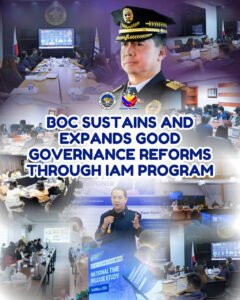
At the core of the IAM drive is the full implementation of the updated Integrity Action Plan (IAP) across all Customs offices, developed with technical backing from the World Customs Organization (WCO). Through corruption risk mapping and alignment with global integrity standards, the BOC tightened audit systems, reduced discretionary loopholes, modernized procedures, and reinforced internal controls.
Translation: less room to cheat, fewer chances to cut corners, and stronger accountability at every level.
CODE OF CONDUCT WITH TEETH
In April 2025, the Bureau approved a revised Code of Conduct, aligned with national laws and the WCO Model Code of Ethics. This wasn’t filed away and forgotten. Under Nepomuceno’s watch, it cascaded bureau-wide, was printed, distributed, and drilled into the system.
The goal is clear—reset the culture, not just the rules.
CONFLICTS OF INTEREST? SHUT DOWN.
Transparency got another boost with Memorandum No. 39-2025, which slammed the door on conflict-of-interest practices. Customs personnel are now barred from doing business with customs brokers and are required to declare familial ties that could compromise impartiality.
No gray areas. No quiet exemptions. Full disclosure or face the consequences.
PUBLIC WATCHDOGS WELCOME
Citizen engagement—long treated as an afterthought—is now a frontline weapon against abuse.
The “Isumbong kay Commissioner” platform gives the public a direct line to the top, cutting through bureaucracy and silence. Complaints are no longer buried—they’re tracked, acted on, and answered.
Meanwhile, the revised Citizens’ Charter, rolled out in late 2025, stripped away vague promises and replaced them with clear service standards, streamlined procedures, and enforceable timelines. Transparency, now written in black and white.
MODERNIZATION BACKED BY PEOPLE AND STRUCTURE
Governance reforms didn’t stop at discipline. The BOC expanded its workforce, implemented merit-based promotions, and invested in local and international training. Organizational restructuring under the Government Optimization Act sharpened efficiency and ensured long-term sustainability.
This is modernization with muscle—not cosmetic change.
THE NEPOMUCENO DOCTRINE
What sets this moment apart is continuity.
Commissioner Ariel F. Nepomuceno didn’t treat reform as a slogan for 2025. He locked it into the Bureau’s DNA for 2026 and beyond. The IAM Program is no longer a campaign—it’s the operating system.
In line with President Ferdinand R. Marcos Jr.’s directive for transparent, efficient, and accountable governance, the Bureau of Customs is signaling that the era of tolerated misconduct is over.
Reforms are standing. Controls are tighter. And the cleanup isn’t slowing down.
In today’s Bureau of Customs, the warning is simple:
If you can’t live with integrity, you don’t belong in the system.