 Bernie Anabo Jr.
By all measures, this was not just another customs report.
This was a full-scale fiscal detonation.
While many government offices struggle to keep pace with targets, the Bureau of Customs – Port of Batangas under District Collector Carmelita M. Talusan—better known on the ground as “Mimel”—has turned the country’s premier energy port into a roaring collection powerhouse that is crushing expectations month after month.
And the numbers? Ruthless.
In March 2026 alone, the Port unleashed a staggering ₱22.21 BILLION in collections against a ₱19.16 billion target—an earth-shaking ₱3.05 BILLION surplus in just one month.
That is not a minor overperformance.
That is domination.
For the first quarter of 2026, Batangas hammered out ₱59.14 BILLION, surpassing its assigned goal of ₱58.75 billion and delivering another surplus to government coffers.
In a time when leakages, smuggling threats, and economic uncertainty continue to batter global trade systems, Batangas didn’t just survive the pressure—it weaponized efficiency.
And right at the center of this relentless customs offensive stands Collector Mimel Talusan.
Inside customs circles, Talusan has built a reputation as a no-nonsense field commander—aggressive on enforcement, relentless on monitoring, and uncompromising when it comes to accountability. Under her watch, the Port of Batangas has become a high-speed revenue engine fueled by discipline, coordination, and precision targeting.
No complacency.
No excuses.
Just results.
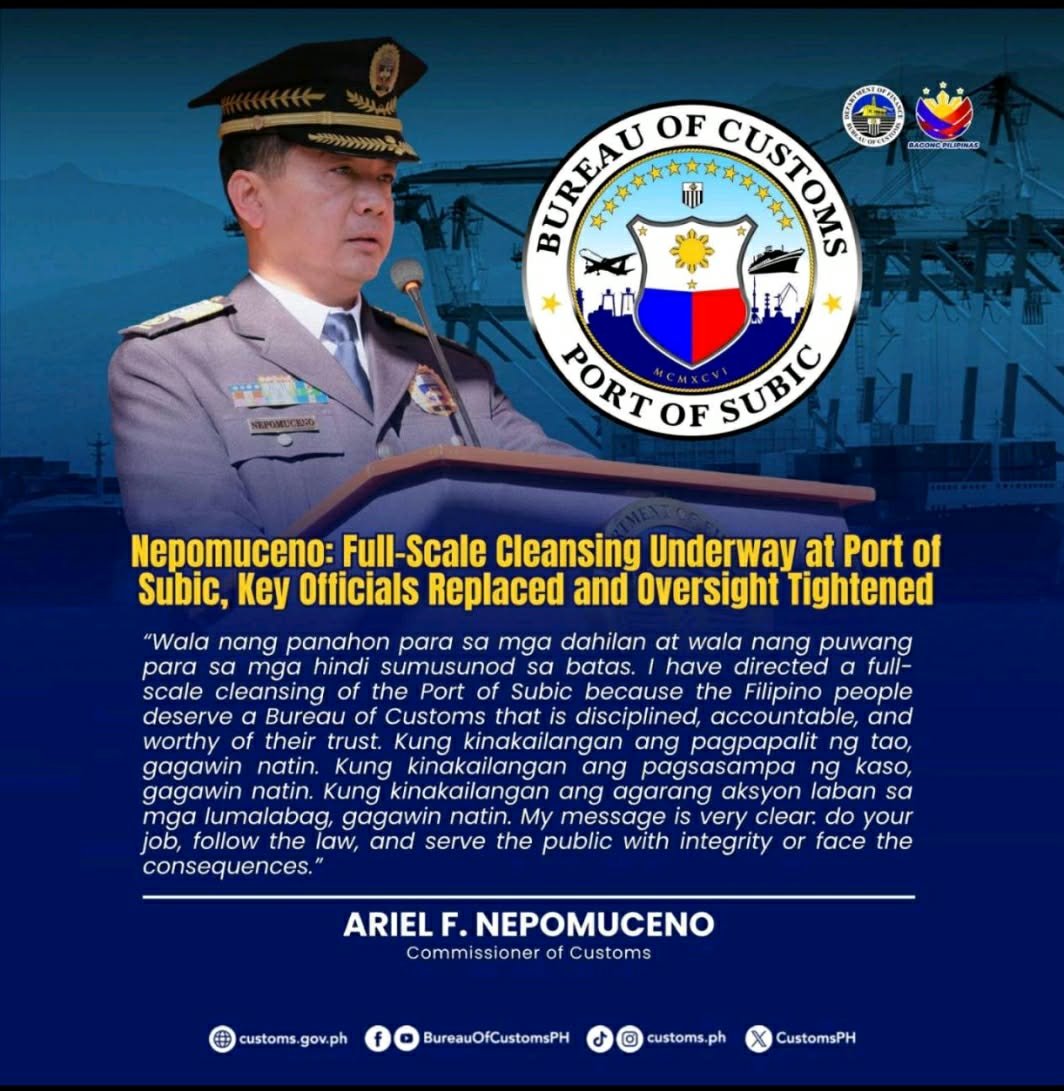
Even Customs Commissioner Ariel F. Nepomuceno openly praised the Port during the April Collectors’ Conference, recognizing Batangas as one of the Bureau’s strongest-performing ports and a model for operational excellence nationwide.
But Batangas’ success story goes beyond raw collections.
Under Talusan’s leadership, the Port launched aggressive monitoring systems, tightened valuation controls, intensified coordination with shipping lines and importers, and deployed real-time tracking mechanisms designed to plug leakages before they even begin.
This is customs modernization with teeth.
The Port also strengthened its anti-smuggling coordination with partner agencies, reinforcing border security while keeping trade moving efficiently—a balancing act many ports struggle to achieve.
And while some offices talk endlessly about reform, Batangas moved ahead with actual modernization tools: digital dashboards, mobile applications, tracking systems, stakeholder engagement programs, and compliance-driven partnerships with the private sector.
The result?
Faster processing.
Stronger collections.
Tighter enforcement.
Commissioner Nepomuceno himself described the Port as “a model of excellence in customs administration,” citing its innovative strategies, operational discipline, and commitment to integrity.
That praise did not come cheap.
It was earned.
Batangas likewise aligned its operations with Nepomuceno’s IAM agenda—Integrity, Accountability, and Modernization—a program now becoming the battle framework for the Bureau’s next-generation customs operations.
But perhaps the strongest weapon of Port of Batangas today is not technology alone.
It is leadership.
Because behind every billion collected, every shipment monitored, every smuggling attempt intercepted, and every operational breakthrough achieved is a workforce driven by a collector who clearly understands one thing:
Pressure creates diamonds.
And under Mimel Talusan, the Port of Batangas is shining like a financial war machine.