 Bernie Anabo Jr.
POM’s Torralba, Clark’s Reyes Deliver the Goods in Nepomuceno’s Revenue Drive
When billions of pesos are on the line, talk is cheap. Collection numbers are not.
And right now, two Customs collection districts are making plenty of noise—not with press releases, but with actual figures.
At the Port of Manila (POM), District Collector Rizalino Jose “RJ” Torralba is leading a collection machine that continues to beat its targets.
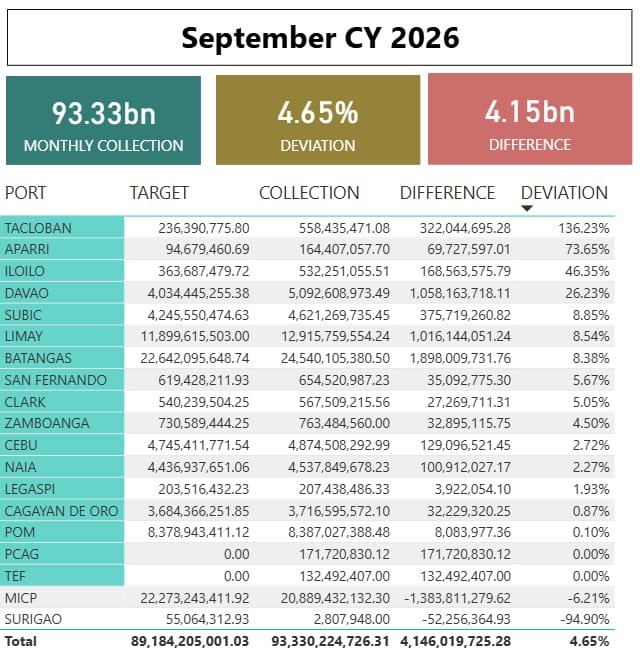
In June alone, POM hauled in ₱7.815 billion, smashing its ₱7.422-billion target by roughly ₱393 million—or 5.30 percent.
Then came July.
Another target surpassed.
That is not a one-month fluke. For port handling billions in duties and taxes, consistent overperformance is precisely the kind of result that gets attention.
And Torralba deserves the spotlight.
POM is the heavyweight. It carries the volume, the pressure and the enormous revenue expectations—and it is delivering.
But do not overlook the action in Clark.
At the Port of Clark (POC), District Collector Jairus Reyes is proving that a smaller collection district can still punch well above its weight.
From January through June 2026, Clark collected ₱2.765 billion, exceeding its semester target by approximately ₱104 million.
Then in July, Clark came out swinging again.
The port reportedly collected ₱396.914 million, beating its monthly target by about ₱37.364 million—or 10.39 percent.
Ten-point-three nine percent!
That is not pocket change.
That is the kind of number that gets the attention of anyone watching government revenue performance.
So what is happening in Manila and Clark?
Simple.
The targets are being chased—and beaten.
This is where Bureau of Customs Commissioner Ariel Nepomuceno’s revenue drive enters the picture.
A Customs reform agenda ultimately has to survive the toughest test of all: What does it produce at the ports?
Policies, programs, modernization initiatives, enforcement campaigns and accountability measures may sound impressive on paper.
But at the end of the day, the scoreboard is the collection report.
And the latest figures from Manila and Clark provide a compelling snapshot of ports performing above target.
Torralba brings the muscle. Reyes brings the efficiency.
POM demonstrates scale.
Clark demonstrates consistency and percentage performance.
And both demonstrate the importance of district-level leadership and personnel who understand that collection targets are not decorative figures on a spreadsheet.
They are obligations to the Filipino taxpayer.
But let us be clear: high collection numbers should never become an excuse to lower the guard against smuggling, undervaluation, misdeclaration and other forms of revenue leakage.
In fact, the opposite should be true.
The more Customs collects, the more aggressively it must protect every peso.
That is where the real challenge begins.
For Commissioner Nepomuceno, the message from Manila and Clark is unmistakable: the revenue drive is producing numbers worth watching.
For Collector RJ Torralba, the challenge is to keep the Port of Manila’s massive revenue engine running without sacrificing enforcement and accountability.
For Collector Jairus Reyes, the task is equally demanding: sustain Clark’s impressive trajectory and prove that today’s numbers are not merely a hot streak, but part of a continuing pattern of performance.
Because Customs is not a debating society.
It is a revenue and enforcement agency.
No amount of grandstanding can replace actual collections. No slogan can substitute for billions delivered to government coffers.
And when the numbers are there, they deserve to be acknowledged.
So here is the bottom line:
POM is producing.
Clark is producing.
Torralba is delivering at one of the country’s biggest ports.
Reyes is delivering at Clark.
And Commissioner Nepomuceno’s revenue agenda now has something far more powerful than rhetoric behind it:
NUMBERS.
In Customs, numbers talk.
And right now, Manila and Clark are talking loud.