 Bernie Anabo Jr.
EXCISE TAXES ON LPG, KEROSENE SUSPENDED — MENDOZA ENFORCES MARCOS’ FUEL-RELIEF ORDER
When global oil prices roar, Filipino families feel the pain at the pump—and in the kitchen.
But this time, Malacañang is not simply watching the price shock unfold.
President Ferdinand “Bongbong” Marcos Jr. has ordered another temporary suspension of excise taxes on LPG and kerosene, while BIR Commissioner Atty. Charlito Martin R. Mendoza moves to put that relief into effect.
That is the headline behind Revenue Memorandum Circular No. 100-2026, issued by the Bureau of Internal Revenue on September 28, implementing Executive Order No. 125, series of 2026, issued by President Marcos on September 25 pursuant to Republic Act No. 12316.
This is not a tax giveaway.
It is a government response to an oil-price squeeze that has the potential to hit ordinary consumers hardest.
MENDOZA: NO DELAY, NO CONFUSION
Under Commissioner Mendoza, the BIR has moved quickly to translate the President’s directive into an operational tax measure.
The trigger was clear: the Department of Energy certified that the one-month average Dubai crude oil price, based on the Mean of Platts Singapore, reached US$99.41 per barrel from August 13 to September 11, 2026—well above the US$80-per-barrel threshold established under RA No. 12316.
And once the statutory conditions were met, the tax machinery had to move.
Mendoza did exactly that.
Under EO No. 125, excise taxes on LPG are fully suspended, except when LPG is used as raw material for petrochemical production or for motive power.
For kerosene, the excise tax is likewise fully suspended, except when used as aviation fuel.
The message is blunt: when the law says temporary relief must be activated, the BIR implements it.
MARCOS PULLS THE TAX LEVER
President Marcos’ latest executive order underscores the government’s use of fiscal policy as a response to extraordinary movements in global petroleum prices.
The mechanism is not permanent. It is tied to specific conditions under RA No. 12316.
That distinction matters.
The administration is not abolishing the excise taxes. It is temporarily suspending them under a law-based trigger, giving consumers and affected sectors a measure of relief while international oil prices remain elevated.
And there is a built-in exit.
The regular excise tax rates will automatically return—without another issuance—one week after the DOE certifies that the one-month average Dubai crude price has fallen below US$80 per barrel, or three months from the effectivity of EO No. 125, whichever comes first.
In other words: relief has a trigger—and so does the return to normal taxation.
ROUND TWO OF THE FUEL-TAX BATTLE
This is not Mendoza’s first encounter with the mechanism.
The BIR previously implemented a similar suspension under EO No. 114, series of 2026, beginning April 17.
That suspension was lifted effective July 8 after the DOE certified that the one-month average Dubai crude oil price had dropped below the applicable US$80 threshold.
Now, the pressure has returned.
And once again, the BIR is being called upon to execute.
THE REAL TEST: RELIEF MUST REACH THE PEOPLE
But here is where the rubber meets the road.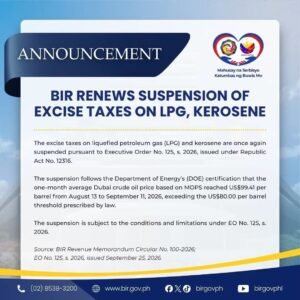
A tax suspension is meaningful only if its economic benefit is ultimately reflected in the real world.
For millions of Filipinos, LPG is not an abstract tax-policy issue.
It is the fuel used to cook breakfast.
It is the cylinder standing in the corner of a small neighborhood eatery.
It is part of the operating cost of businesses already battling higher prices.
Kerosene, meanwhile, remains relevant to consumers and sectors that depend on it for specific uses.
That is why the implementation of EO No. 125 deserves close public attention.
The government has opened the door for relief. The question now is how much of that relief will actually reach consumers.
MENDOZA AT THE TAX FRONTLINE
For Commissioner Charlito Martin Mendoza, the challenge is bigger than issuing another memorandum.
The BIR must ensure that the suspension is properly implemented, understood and administered within the boundaries of the law.
There should be no confusion.
No arbitrary interpretation.
No unnecessary bureaucratic roadblocks.
And certainly no misuse of a temporary tax measure.
Mendoza’s role is therefore critical: turn the President’s policy directive and the law’s statutory mechanism into disciplined implementation.
That is where tax administration meets public service.
MARCOS’ MESSAGE: GOVERNMENT CAN RESPOND
President Marcos, meanwhile, is using the authority granted by RA No. 12316 to respond to a measurable external pressure: elevated international crude prices.
Whether this temporary suspension ultimately provides substantial relief will depend on market conditions, supply chains, pricing practices and how the benefit moves through the distribution system.
But the policy direction is unmistakable.
When the global oil shock crosses the statutory threshold, the government can pull the tax lever.
And right now, that lever has been pulled again.
THE BOTTOM LINE
Oil prices may be determined in global markets, but their consequences are painfully local.
They reach the household kitchen.
They reach transportation.
They reach businesses.
They reach the price of goods.
That is why EO No. 125 and RMC No. 100-2026 are more than bureaucratic documents. They are part of the government’s response to an economic pressure felt far beyond the corridors of Malacañang and the BIR.
President Marcos has activated the relief mechanism.
Commissioner Mendoza has put the tax agency into action.
Now comes the most important part:
Make the relief count.
Because when the price of oil explodes, Filipino consumers should not be left carrying the entire blast.