
 Bernie Anabo Jr.
The message from the Bureau of Internal Revenue (BIR) is loud, clear, and uncompromising: DIGITALIZATION MUST SERVE THE TAXPAYERS — NOT BECOME A LICENSE TO EXPLOIT THEM!
Under the leadership of BIR Commissioner Atty. Charlito Martin R. Mendoza Jr., the tax agency is tightening the rules for Electronic Invoicing Service Providers (ESPs), sending a powerful warning to technology companies seeking to enter the electronic invoicing business: accreditation is a responsibility, not a blank check to squeeze Filipino taxpayers!
With Revenue Memorandum Circular No. 110-2026, issued on October 13, 2026, the BIR has established an accreditation framework designed to ensure that electronic invoicing providers meet technical standards, protect taxpayer information, maintain reliable systems, and operate with transparency and accountability.
But the most explosive part of the new policy is its direct message to prospective providers: DO NOT USE MANDATORY TAX COMPLIANCE AS AN EXCUSE TO CHARGE EXORBITANT FEES!
This is the kind of tough, taxpayer-centered leadership that businesses need — modernization without exploitation, digital transformation without unnecessary financial burdens, and technological progress without sacrificing public service.
MENDOZA: TAXPAYERS ARE NOT CASH COWS!
Commissioner Mendoza deserves the spotlight for putting taxpayer protection at the center of the BIR’s digital transformation agenda.
During the briefing for prospective ESPs at the BIR National Office, Mendoza made it clear that technical compliance alone would not be enough. Providers must also demonstrate a commitment to fair pricing, dependable service, and responsible business practices.
“Please do not use the mandatory nature of electronic invoicing as a reason to charge excessive fees,” the Commissioner warned.
That statement should reverberate across the industry!
With covered taxpayers required to comply with electronic invoicing rules by December 31, 2026, the transition creates a significant market for companies offering electronic invoicing solutions. But where compliance becomes mandatory, the government must remain vigilant against unreasonable pricing, restrictive contracts, and business practices that leave taxpayers with no practical choice.
Mendoza’s position draws a critical line: THE GOVERNMENT MAY REQUIRE COMPLIANCE, BUT THAT DOES NOT GIVE PRIVATE PROVIDERS THE RIGHT TO ABUSE THE MARKET!
The five-year accreditation period, subject to annual review, also establishes a framework for continuing oversight. Providers must meet requirements involving information security, system reliability, data protection, and business continuity.
These are not minor technical details. They are essential safeguards in an environment where business transactions, sales records, and sensitive taxpayer information increasingly move through digital systems.
BAQUIRAN: OPERATIONS MUST DELIVER, NOT JUST ISSUE RULES!
Deputy Commissioner for Operations Group Atty. Vener Baquiran also deserves recognition as the BIR moves to translate its electronic invoicing policies into practical compliance requirements.
A policy is only as effective as its implementation.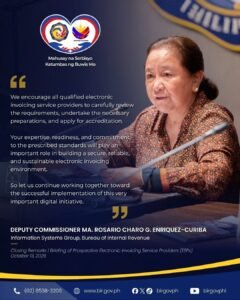
The Operations Group has an important role in ensuring that taxpayers understand their obligations, that implementation is consistent, and that legitimate businesses are not buried under confusion, unnecessary red tape, or avoidable compliance costs.
As the December 31 deadline approaches, taxpayers need clear guidance, predictable procedures, and responsive assistance — not conflicting interpretations or last-minute surprises.
The challenge is to make the transition orderly and fair, particularly for businesses that must choose between developing their own systems, purchasing commercial solutions, or engaging accredited service providers.
The BIR must ensure that the new framework does not become a source of unnecessary hardship for small and medium-sized enterprises.
COMPLIANCE MUST BE CLEAR. IMPLEMENTATION MUST BE FAIR. TAXPAYER SERVICE MUST BE NON-NEGOTIABLE.
That is where operational leadership will be tested.
ENRIQUEZ-CURIBA: THE TECHNOLOGY MUST WORK — AND TAXPAYER DATA MUST BE SAFE!
Deputy Commissioner for Information System Group Ma. Rosario Charo G. Enriquez-Curiba stands at the center of another crucial challenge: ensuring that digital tax administration is backed by dependable systems, strong information security, and sound technological governance.
Digitalization is not simply about replacing paper with screens. It is about building systems that work when taxpayers need them, safeguard confidential information, and maintain the integrity of electronic records.
A system failure can disrupt business transactions. Weak security can expose sensitive information. Poorly managed data transfers can create serious difficulties for businesses trying to change providers or retrieve their records.
That is why the accreditation framework’s technical and security requirements matter.
The BIR must demand that prospective providers demonstrate their capacity to deliver reliable services, protect information, and maintain continuity even when operational problems arise.
And there is another provision that deserves special attention: taxpayer access to records.
Under the new framework, providers must protect taxpayers against vendor lock-in by ensuring continued access to their records, including in situations involving unpaid fees, contractual disputes, or transfers to another provider.
In plain language, businesses must not be held hostage by their technology vendors.
YOUR BUSINESS RECORDS ARE YOUR BUSINESS RECORDS — NOT A WEAPON FOR A PROVIDER TO USE AGAINST YOU!
That safeguard is vital to fair competition and responsible digital transformation.
NO VENDOR LOCK-IN! NO HIDDEN CHARGES! NO SHORTCUTS!
The new accreditation rules send a strong signal that the BIR is not prepared to let digital modernization run ahead of accountability.
Providers must disclose their fees fully before onboarding taxpayers. They must comply with continuing requirements. And they must operate within a framework intended to protect the interests of the businesses required to use their services.
The annual review mechanism is particularly important because accreditation should not be treated as a permanent privilege immune from scrutiny.
The BIR must remain alert to complaints involving excessive fees, unreliable systems, data access restrictions, and other possible violations of accreditation requirements. Where evidence of noncompliance emerges, the agency should act under the applicable rules and due process.
The goal is not to punish legitimate technology businesses. The goal is to establish a competitive and trustworthy environment where providers can earn profits without compromising taxpayer rights.
FAIR BUSINESS IS WELCOME. TAXPAYER EXPLOITATION IS NOT!
DECEMBER 31 DEADLINE: PREPARE NOW, BUT DON’T PANIC!
Under RMC No. 98-2026, covered taxpayers are required to comply with electronic invoicing requirements by December 31, 2026.
Taxpayers may use their own electronic invoicing systems, commercially acquired solutions, or the services of accredited ESPs, subject to the applicable requirements.
This means businesses should begin reviewing their current invoicing processes, identifying the solution appropriate to their operations, and confirming the requirements applicable to them.
The BIR, for its part, must continue providing accessible guidance so that taxpayers can make informed decisions instead of being pressured into costly arrangements.
The accreditation framework will only achieve its purpose if businesses understand the rules, providers comply with the standards, and enforcement is consistent.
No taxpayer should be forced to make a rushed decision because of inadequate information. Nor should the deadline be exploited as a marketing weapon to pressure businesses into accepting unreasonable contracts.
MARCOS DIGITALIZATION AGENDA: MODERNIZATION WITH A HUMAN FACE!
The initiative supports the digitalization agenda of President Ferdinand R. Marcos Jr. and the efforts of Finance Secretary Frederick D. Go to make government transactions more efficient, accessible, and business-friendly.
But digital transformation must be measured by more than the number of systems launched or transactions processed electronically.
It must also be measured by whether businesses save time, whether compliance becomes more manageable, whether taxpayer information remains protected, and whether government services become more responsive.
Mendoza’s call for “Service Excellence with Integrity and Professionalism” reinforces the principle that public service and private-sector participation must both be anchored in accountability.
The message to prospective ESPs is straightforward: meet the standards, disclose the costs, protect the records, and deliver dependable service.
The message to taxpayers is equally important: understand your obligations, examine your options, and insist on transparency.
THE BOTTOM LINE: DIGITALIZATION MUST NOT BECOME A TAX ON THE TAXPAYER!
Commissioner Mendoza, Deputy Commissioner Baquiran, and Deputy Commissioner Enriquez-Curiba now face the important task of ensuring that the new accreditation framework delivers what it promises.
The real test will not be the announcement of rules. It will be their consistent implementation, the quality of taxpayer assistance, the reliability of accredited systems, and the government’s willingness to address substantiated complaints.
The BIR must modernize without creating unnecessary burdens. It must encourage innovation without surrendering oversight. And it must ensure that technology providers compete on service, reliability, security, and fair pricing.
Because at the end of the day, the Filipino taxpayer is not merely a source of government revenue. The taxpayer is a stakeholder whose rights, resources, and trust must be protected.
MENDOZA’S CHALLENGE IS CLEAR: MODERNIZE THE TAX SYSTEM, PROTECT THE PEOPLE, AND KEEP GREED OUT OF THE DIGITAL TRANSITION!
That is the standard taxpayers should demand — and the standard the BIR must deliver.
MAHUSAY NA SERBISYO, KATUMBAS NG BUWIS MO!