
 Dr. Bernie Anabo Jr
The Senate is supposed to be the bastion of democracy, the guardian of the Constitution, and the last line of defense against political abuse. But when legal procedures appear to take a back seat to political maneuvering, the Filipino people have every reason to raise hell!
The controversy surrounding the petition seeking the disqualification of Senator Erwin Tulfo has exposed an ugly question inside the hallowed halls of the Senate: Are some senators defending the rule of law—or playing political games at the expense of a colleague elected by millions of Filipinos?
Senators Robin Padilla, Pia Cayetano, and Camille Villar are now under intense criticism for voting to entertain a petition that opponents described as procedurally defective and filed beyond the prescribed deadline.
And that vote deserves serious scrutiny.
A DEADLINE IS A DEADLINE. THE LAW CANNOT BEND TO POLITICAL CONVENIENCE!
If a petition is filed beyond the deadline established by law or applicable rules, the fundamental question is straightforward: Why should it receive special consideration simply because a senator’s political future is at stake?
The law is not a political buffet where public officials can pick the rules they like and ignore the ones they find inconvenient.
Procedural deadlines exist for a reason. They protect fairness, certainty, and the integrity of judicial and quasi-judicial proceedings. They are not optional decorations to be discarded whenever a political dispute heats up.
If the petition against Tulfo failed to meet the applicable procedural requirements, then those defects must be confronted squarely—not swept under the rug in the name of political maneuvering.
However, the distinction must be clear: voting to entertain a petition does not, by itself, establish that a senator violated the law. The legality of the vote and any allegation of misconduct must be assessed against the governing rules and the actual record.
But make no mistake: the public has every right to demand an explanation when elected officials support reviving a challenge that their critics consider legally dead on arrival.
TULFO WON A MANDATE—NOT A POLITICAL DEBT!
Senator Erwin Tulfo did not simply walk into the Senate through a backdoor. He secured a place in the country’s highest legislative chamber through the electoral process.
That mandate deserves respect.
In a democracy, the will of the electorate cannot be treated as an inconvenience whenever political opponents find an opportunity to challenge a rival. Elections are not meaningless exercises that can be casually undermined by endless political warfare.
Tulfo’s victory does not place him above the law. No elected official is untouchable, and every legitimate challenge must be examined under the Constitution and applicable statutes.
But the reverse is equally true: No senator should be subjected to a politically charged campaign that disregards the very legal standards everyone is obligated to follow.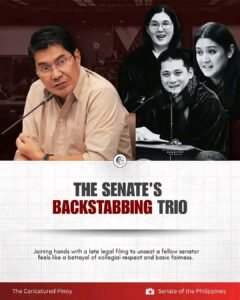
The law must apply equally to Tulfo, Padilla, Cayetano, Villar, and every other public official. No exemptions. No double standards. No political shortcuts.
If Tulfo is entitled to a dismissal because the petition failed to comply with mandatory requirements, that entitlement must be respected. If a valid legal basis exists to proceed, it must be established through proper proceedings—not political theatrics.
PADILLA, CAYETANO, VILLAR: THE PEOPLE DESERVE ANSWERS!
The votes of Padilla, Cayetano, and Villar have placed their judgment under the public microscope.
Why support entertaining a petition that has been challenged on procedural grounds? What specific legal reasoning justified their position? Were they persuaded by a valid interpretation of the applicable rules, or did political considerations influence their judgment?
These are fair questions that deserve substantive answers.
Senators are not ordinary spectators in a legal controversy. They are lawmakers entrusted with defending the Constitution and setting an example of accountability. Their decisions carry weight because the public expects them to exercise judgment based on law, evidence, and principle.
That is precisely why their votes must withstand public scrutiny.
Political power is not a license to weaponize legal proceedings against a rival.
If their position was legally sound, they should explain it openly and defend it with facts and applicable law. If it cannot withstand that scrutiny, the public has every right to question the wisdom and fairness of their decision.
What they cannot reasonably expect is blind public acceptance simply because they hold powerful positions in the Senate.
Bernie
The Filipino people are tired of political double standards.
They are tired of watching public officials turn government institutions into battlegrounds for personal rivalries while urgent national problems demand attention.
LACSON’S WARNING SHOULD NOT BE IGNORED
Senator Panfilo “Ping” Lacson’s reported criticism of the move adds another layer to the controversy, particularly regarding the petition’s procedural deficiencies and questions about the petitioner’s legal standing.
Those concerns should not be dismissed as mere political noise.
Legal standing matters. Filing deadlines matter. Jurisdiction and procedural requirements matter. Without respect for these safeguards, legal proceedings risk becoming instruments of harassment rather than mechanisms for justice.
The proper response is not to prejudge anyone’s motives, but to examine the record, identify the applicable rules, and demand a clear explanation for every consequential vote.
If the petition was legally defective, the public deserves to know why it was entertained. If it satisfied the requirements, the legal basis should be made equally clear.
Transparency is the antidote to suspicion.
BACKSTABBING IS NOT LEGISLATION!
Tulfo’s reported social-media cartoon depicting a figure being stabbed in the back captured the bitterness of the political dispute. Whether one views the image as an expression of frustration or a political message, it reflects a deeper problem: public confidence suffers when disputes among elected officials appear to overshadow their responsibilities to the nation.
The Senate is not a private club. It is not a battlefield for personal grudges. And it certainly must not become a playground where political rivals attempt to destroy one another while ordinary Filipinos struggle with rising prices, inadequate services, unemployment, and economic uncertainty.
The public did not elect senators to spend their time nursing grudges. They elected them to legislate, investigate wrongdoing fairly, protect public funds, and deliver solutions.
Every hour consumed by political score-settling is an hour that could have been spent addressing the country’s pressing problems.
If the senators involved believe their actions serve the public interest, they should prove it through transparent reasoning and respect for the law—not through political posturing.
THE FINAL VERDICT: LET THE LAW SPEAK, NOT POLITICAL AMBITION!
This controversy should serve as a warning to every member of the Senate: The Constitution is not a weapon to be pointed at political enemies and a shield to be raised for political allies.
Padilla, Cayetano, and Villar owe the public a clear explanation of their votes. Their critics are entitled to challenge their judgment. But accusations of illegality must be established by the applicable rules and evidence, not merely by the intensity of political outrage.
Padilla, Cayetano, and Villar owe the public a clear explanation of their votes. Their critics are entitled to challenge their judgment. But accusations of illegality must be established by the applicable rules and evidence, not merely by the intensity of political outrage.
Padilla, Cayetano, and Villar owe the public a clear explanation of their votes. Their critics are entitled to challenge their judgment. But accusations of illegality must be established by the applicable rules and evidence, not merely by the intensity of political outrage.
Padilla, Cayetano, and Villar owe the public a clear explanation of their votes. Their critics are entitled to challenge their judgment. But accusations of illegality must be established by the applicable rules and evidence, not merely by the intensity of political outrage.
For Senator Erwin Tulfo, the principle is equally clear: his electoral mandate deserves respect, his rights deserve protection, and any attempt to challenge his eligibility must stand or fall on the law.
No senator should be removed through political pressure. No petition should be revived through favoritism. And no public official should be excused from accountability because of rank, influence, or alliances.
Bernie
THE PEOPLE’S MANDATE IS NOT A POLITICAL PLAYTHING. THE LAW IS NOT A TOY. AND THE SENATE IS NOT A DEN OF BACKSTABBERS!
If the petition is defective, let the proper legal process dispose of it. If it has merit, let the evidence establish that merit. But let no one mistake political maneuvering for justice.
In the end, the real judge is not the loudest senator, the most powerful political clan, or the most aggressive partisan.
It is the rule of law—and the Filipino people who expect their elected representatives to uphold it.
Because when political ambition is allowed to overshadow legal fairness, democracy itself becomes the casualty.
