 Morning Standard News Team

When the allegedly less knowledgeable pass while the competent are left behind, something deserves a closer look inside the Bureau of Customs.
A serious allegation is now demanding attention at the Bureau of Customs (BOC): Is someone allegedly selling promotions behind the scenes?
This is no ordinary complaint from disappointed examinees. It is an issue that strikes at the heart of fairness, meritocracy, and integrity in government service.
A letter dated October 19, 2026, addressed to Customs Commissioner Ariel F. Nepomuceno and bearing a BOC Message Center receiving stamp dated October 20, 2026, raises disturbing allegations concerning the recently concluded promotion examination.
According to the letter signed in the name of BOCEA, certain individuals allegedly approached prospective examinees even before the examination, promising assistance in helping them pass. After the examination, these individuals allegedly demanded a staggering ₱120,000 per candidate in exchange for inclusion in the list of successful examinees.
Let that sink in.
₱120,000—for an alleged chance to pass a government promotion examination?
If these allegations are substantiated, this is not merely an administrative irregularity. It could represent a serious assault on the principles of meritocracy and integrity that should govern public service.
To be clear, these remain allegations that must be independently investigated. The letter alone does not establish that bribery, examination manipulation, or the sale of promotions actually occurred. But the allegations are serious enough to demand answers.
KNOWLEDGE OR CONNECTIONS—WHAT REALLY COUNTS?
Here lies the most troubling question.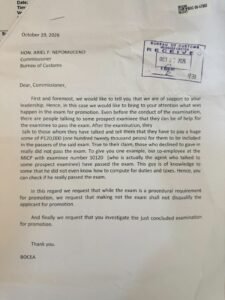
What happens when an employee who possesses the necessary knowledge, experience, and technical competence fails an examination, while another candidate—whose competence is being questioned—passes?
Does the result reflect genuine merit? Were the same standards applied to everyone? Was the examination administered and evaluated fairly?
These questions cannot be dismissed with a shrug.
The complaint specifically identifies an examinee at the Manila International Container Port (MICP), referred to by examinee number 10120. The letter alleges that this individual had limited knowledge of how to compute customs duties and taxes. It further claims that the person allegedly acted as an intermediary who spoke with prospective examinees.
These are serious claims, and they must be tested against evidence—not rumors, personal opinions, or assumptions.
The BOC should examine the official examination records, applicable scoring standards, qualifications of successful candidates, and any credible evidence that might establish whether the process was compromised.
The individual identified in the complaint must also be given a fair opportunity to respond.
But one principle must remain non-negotiable: technical competence matters.
The Bureau of Customs is entrusted with revenue collection, customs assessment, trade facilitation, and border protection. These responsibilities demand knowledgeable, capable, and ethical personnel. In customs work, competence is not merely a qualification on paper. It can directly affect government revenue, compliance with the law, and the delivery of public service.
If the promotion examination failed to measure competence fairly, the process deserves scrutiny.
And if anyone used money, influence, or improper arrangements to manipulate the results, those responsible must be held accountable in accordance with the law and the evidence.
₱120,000: THE ALLEGED PRICE OF A PROMOTION?
If the alleged ₱120,000 payment scheme is proven, the consequences would extend far beyond the careers of the employees involved.
It would raise fundamental questions about the credibility of the entire promotion system.
Imagine an employee who spends nights reviewing, studies customs regulations, masters the computation of duties and taxes, and relies on years of experience to qualify for advancement.
Now imagine that employee discovering that someone else allegedly secured a passing result through money rather than merit.
What message would that send to hardworking personnel who believe that competence and integrity are the keys to professional advancement?
What would happen to employee morale if promotion were perceived not as a reward for capability but as a privilege allegedly available to those willing to pay?
And what would that mean for public confidence in an agency that is expected to enforce the law without fear or favor?
A government promotion system must never become a marketplace where positions are allegedly bought and sold.
No envelope, personal connection, or secret arrangement should ever take precedence over qualifications, competence, experience, and integrity.
COMMISSIONER NEPOMUCENO, THE PUBLIC DESERVES ANSWERS!
Commissioner Ariel F. Nepomuceno, this is an opportunity to demonstrate that good governance is more than a slogan.
Your administration should ensure that this complaint receives a serious, impartial, and documented investigation.
The appropriate response is neither to dismiss the complaint outright nor to presume that everyone mentioned in it is guilty. The proper course is to establish the facts, protect the rights of everyone concerned, and make the findings known through the appropriate channels.
The questions are straightforward:
* Who allegedly demanded ₱120,000, and is there credible evidence such as messages, receipts, witness statements, or other documentation?
* What procedures governed the administration, scoring, and validation of the promotion examination?
* Were the same qualification standards and evaluation criteria applied consistently to all examinees?
* Is there sufficient basis for an independent review of the examination results?
* Are there confidential reporting mechanisms to protect employees who may have direct knowledge of the alleged scheme from retaliation?
The investigation should be conducted by an impartial body or office with no conflict of interest. Relevant records should be preserved, and any substantiated violations should be referred to the appropriate authorities.
Employees who come forward in good faith should be protected from unlawful retaliation, while those accused must be afforded due process.
Transparency is the best answer to suspicion. Evidence is the best answer to allegations. Accountability is the best answer to proven wrongdoing.
DO NOT PUNISH THE INNOCENT—BUT DO NOT IGNORE THE COMPLAINT!
The BOCEA letter also requests that failure to pass the examination should not automatically disqualify an applicant from promotion.
That request must be evaluated against applicable Civil Service Commission rules, BOC promotion policies, and the specific qualification requirements for the position concerned. An examination requirement cannot simply be disregarded when it is legally mandatory. However, where credible evidence raises questions about the integrity of the process, a fair review may be warranted.
The objective must not be to favor those who failed or to protect those who passed.
The objective must be to ensure that every candidate is treated fairly under the same rules.
If the examination was conducted properly, the Bureau should be able to demonstrate that through credible documentation and a transparent review.
If irregularities occurred, those responsible should be identified and held accountable in accordance with the law.
And if the allegations cannot be substantiated, the findings should also make that clear so that the reputations of innocent individuals are not unfairly damaged.
That is what institutional integrity demands.
THE ULTIMATE QUESTION: COMPETENCE OR CASH?
The Bureau of Customs cannot afford a promotion system that employees perceive as vulnerable to favoritism, manipulation, or the influence of money.
Positions in government are not prizes for the best-connected individual, nor should they be available to whoever can allegedly produce the largest amount of cash.
They should go to qualified and deserving candidates under lawful, transparent, and consistently applied standards.
If the allegations in the BOCEA letter are proven, the damage would not be limited to one examination. It would undermine employee confidence in the institution and raise serious questions about the integrity of its promotion procedures.
If the allegations are disproven, a credible investigation would serve an equally important purpose: clearing innocent individuals and restoring confidence in the results.
Either way, the public deserves the truth.
Commissioner Nepomuceno must ensure that this complaint is not buried in paperwork, dismissed as office gossip, or allowed to fade into silence without a proper examination of the facts.
The issue is bigger than one examinee, one examination, or one alleged payment.
It is about whether hard work still matters. Whether technical knowledge still counts. Whether honest employees can advance without wondering if someone else has an unfair advantage.
And whether the Bureau of Customs is prepared to defend meritocracy when its integrity is called into question.
NO ENVELOPES. NO FAVORITISM. NO BUYING OF POSITIONS. MERIT, COMPETENCE, AND INTEGRITY MUST PREVAIL!
Because in public service, a promotion must be earned—not allegedly purchased.
The allegations cited in this column are based on the contents of the letter attributed to BOCEA. They have not been independently verified, and no finding of wrongdoing is implied against any person identified or discussed in the complaint.

 Bernie Anabo Jr.