 Morning Standard News Team

Valid permits are not a license to destroy. When the future of the Sierra Madre is at stake, government must look beyond mining contracts, export figures, and corporate assurances.
The question is no longer simply whether a mining company has the permits to operate in Dinapigue, Isabela. The bigger question is whether the government is doing everything within its power to ensure that the extraction of the country’s mineral wealth will not come at the expense of its forests, watersheds, rivers, wildlife, and the future of generations yet unborn.
Mr. President Ferdinand Marcos Jr., the people deserve answers.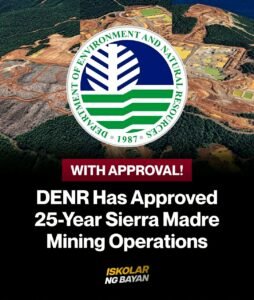
How much environmental damage are we willing to risk in exchange for the commercial extraction of nickel? And who will bear the consequences if the damage becomes irreversible?
These are not anti-development questions. They are questions of accountability, environmental justice, and responsible governance.
The reported nickel mining operations in Dinapigue, situated within the Sierra Madre mountain range, deserve the closest possible scrutiny from the Department of Environment and Natural Resources (DENR) and the Mines and Geosciences Bureau (MGB).
MGB Regional Director Mario Ancheta was quoted as saying: “All of the required permits for its operations were all valid.”
But with all due respect, Director Ancheta, valid permits should be the beginning of environmental scrutiny—not the end of the conversation.
A permit establishes legal authority to conduct specified activities under applicable conditions. It does not automatically establish that every operation is environmentally safe, that every regulatory requirement is being met, or that every potential impact on surrounding communities has been adequately addressed.
The public needs more than assurances. It needs transparent monitoring, independent verification, and credible evidence that environmental safeguards are working.
THE PRICE OF NICKEL: WHO PAYS WHEN NATURE SUFFERS?
According to the information provided for this column, the mining project operates under a 25-year Mineral Production Sharing Agreement (MPSA), extracting nickel ore—including saprolite and limonite—through surface mining.
Corporate disclosures reportedly indicate exports of approximately 300,000 wet metric tons of nickel ore in 2025, followed by another 300,000 wet metric tons during the first six months of 2026.
These figures point to substantial commercial activity. They also raise legitimate questions about the scale of extraction, the cumulative environmental footprint, and the effectiveness of safeguards governing the project.
Nickel is a valuable mineral. But the Sierra Madre is worth far more than a shipment of ore.
The mountain range is a major natural barrier against destructive weather systems affecting eastern Luzon. Its forests and watersheds support biodiversity, help regulate water flows, protect soil, and sustain communities whose livelihoods depend on the natural environment.
When vegetation is removed and land is excavated, the potential consequences include erosion, sediment runoff, slope instability, and deterioration of nearby water resources. The actual risks depend on the terrain, mining methods, drainage systems, rainfall, and the effectiveness of environmental controls.
These are precisely the matters that regulators must investigate, rather than simply assure the public that permits are in order.
What happens to the soil after extraction? Where does the runoff go during heavy rains? Are nearby rivers and coastal waters being tested regularly? Is rehabilitation keeping pace with the disturbance of the land?
The people of Dinapigue deserve documented answers.
A ₱2.5-MILLION FINE THAT DEMANDS ANSWERS
More troubling is the information that, in May 2026, the mining operator was fined ₱2.5 million by the Pollution Adjudication Board for violations of Republic Act No. 9275, or the Philippine Clean Water Act of 2004.
The operator reportedly said it had undertaken corrective measures to address the violations and comply with environmental requirements.
That response must be evaluated on the strength of evidence—not merely accepted as a corporate assurance.
What specific violations were established? Which water bodies or discharges were involved? What corrective measures were ordered? Have these measures been independently verified? Has the company fully complied with the Pollution Adjudication Board’s final order, and have subsequent inspections confirmed that the problem has been resolved?
These are fair questions. They are not a declaration that the company has committed additional violations.
A monetary penalty is not, by itself, proof that all environmental problems have been resolved. Nor should a previously established violation be ignored simply because a company holds other valid permits.
Bernie
A monetary penalty is not, by itself, proof that all environmental problems have been resolved. Nor should a previously established violation be ignored simply because a company holds other valid permits.
The DENR and MGB must make the relevant findings, compliance records, and follow-up monitoring results accessible to the public, subject to applicable disclosure rules.
Environmental compliance must be measured by what happens on the ground—not by what appears on paper.
THE LAWS THAT MUST NOT BE TREATED AS EMPTY PROMISES
Several Philippine laws provide the legal framework for determining whether mining operations are complying with their environmental obligations.
1. Republic Act No. 9275 — Philippine Clean Water Act of 2004
This law governs the protection of water quality and the prevention and control of water pollution. The reported Pollution Adjudication Board fine is directly relevant to this statute.
The government should disclose the established findings and determine whether the operator has fully complied with the applicable corrective orders and continuing water-quality requirements.
The reported fine establishes a reason for serious scrutiny; it does not, on its own, establish a new or continuing violation today.
2. Republic Act No. 7942 — Philippine Mining Act of 1995
The Philippine Mining Act imposes environmental responsibilities on mining contractors and permit holders.
Section 69 requires an environmental protection and enhancement program covering the term of the mineral agreement or permit, including rehabilitation, revegetation, reforestation, slope stabilization, watershed development, and water conservation.
Section 70 provides for environmental impact assessment and an Environmental Compliance Certificate (ECC), subject to the law’s applicable requirements.
Section 71 addresses the rehabilitation of excavated, mined-out, tailings-covered, and disturbed areas. Section 67 also authorizes the regional director, under the conditions specified by law, to require corrective action and to suspend operations when imminent danger to life or property warrants it.
These provisions must be enforced. If evidence establishes noncompliance, the responsible agencies must apply the appropriate remedies and sanctions.
3. Presidential Decree No. 1586 — Philippine Environmental Impact Statement System
This decree establishes the Environmental Impact Statement System, including the ECC framework for covered projects.
The relevant authorities should verify whether the project is operating within the scope of its environmental clearance, complying with its conditions, and implementing the mitigation measures required by its approved environmental documents.
An ECC is not an unconditional guarantee that environmental harm cannot occur. It comes with responsibilities that must be monitored and enforced.
4. Republic Act No. 11038 — Expanded National Integrated Protected Areas System Act of 2018
This law strengthens the protection of areas officially included in the National Integrated Protected Areas System.
Its relevance to any particular mining activity in Dinapigue depends on the precise location of the mining footprint, applicable protected-area boundaries, and the project’s legal status.
The DENR should therefore publicly clarify whether any part of the project overlaps a protected area or otherwise affects an area subject to specific statutory restrictions. No such overlap should be assumed without verified maps and official records.
Bernie
Edited
5. Republic Act No. 9003 — Ecological Solid Waste Management Act of 2000
This law establishes requirements for ecological solid-waste management. Its applicability to specific waste streams generated by mining must be assessed alongside the rules governing mine wastes, hazardous materials, and other applicable environmental regulations.
The relevant agencies should determine whether waste handling, disposal, and related activities comply with the laws and permits that govern them.
These statutes are not interchangeable, and the available information does not establish that the mining operator has violated every law listed above. The confirmed legal finding cited in the supplied information concerns the Clean Water Act. The other laws provide standards and obligations that regulators should examine against the project’s actual records and conduct.
MR. PRESIDENT, PLEASE LOOK BEYOND THE EXPORT FIGURES
President Marcos, environmental protection cannot be reduced to a bureaucratic exercise in checking documents.
The government has a responsibility to balance economic development with the constitutional duty to protect and advance the people’s right to a balanced and healthful ecology. That responsibility becomes particularly important when industrial activities take place in an ecologically significant mountain range.
We therefore call on the President to direct the DENR and the MGB, within their respective legal mandates, to conduct a rigorous and transparent review of the Dinapigue mining operation.
This review should include:
An independent environmental audit of the mining footprint, including forest disturbance, erosion, slope stability, drainage, and rehabilitation.
Public disclosure of relevant water-quality monitoring results, inspection reports, environmental compliance findings, and the status of the Pollution Adjudication Board’s order.
Verification of the company’s ECC, MPSA conditions, environmental protection and enhancement programs, rehabilitation commitments, and applicable financial assurance mechanisms.
An assessment of cumulative impacts, including the combined effects of mining, access roads, land disturbance, and related activities on nearby watersheds and communities.
Meaningful consultation with affected residents, local government units, environmental experts, and other stakeholders.
Prompt enforcement of any established violations, including suspension or other lawful remedies when the evidence and applicable law warrant such action.
If the evidence demonstrates serious or continuing noncompliance, the authorities must not hesitate to impose the appropriate sanctions. Where the law authorizes suspension, cancellation, or other enforcement measures, these should be considered on the basis of verified findings and due process.
The objective is not to condemn a company without evidence. The objective is to ensure that no company, regardless of its economic importance, operates beyond the reach of environmental law.
MGB: YOUR MANDATE IS MORE THAN ISSUING PERMITS
To Director Mario Ancheta and the officials of the Mines and Geosciences Bureau: the public is entitled to know not only whether the permits are valid, but also whether the conditions attached to those permits are being faithfully observed.
How frequently are inspections conducted? What do the monitoring reports reveal? What corrective measures have been completed and independently verified? Are rehabilitation commitments being fulfilled? What mechanisms ensure that the environmental consequences of extraction will not be passed on to future generations?
The Bureau must be willing to answer these questions with evidence.
The DENR and MGB should also coordinate with the Environmental Management Bureau and other appropriate agencies to ensure that water pollution, mine rehabilitation, environmental impact assessment, and protected-area concerns are addressed under the correct legal framework.
Regulators must never become so focused on the legality of extraction that they lose sight of the long-term condition of the land being extracted.
A government permit is a public responsibility. It must never become a shield against legitimate scrutiny.
THE FUTURE WILL NOT BE RESCUED BY A PRESS RELEASE
Imagine a future in which a community discovers that its water resources have deteriorated, its hillsides have become more vulnerable to erosion, or its natural environment has been permanently altered.
Imagine residents asking why the warning signs were not investigated while the operation was still ongoing.
Imagine officials explaining that the necessary permits had been issued.
Would that answer be enough?
No amount of paperwork can restore an ecosystem that has suffered irreversible damage. Rehabilitation may help, but some environmental losses are difficult, expensive, or impossible to reverse fully.
That is why prevention, independent monitoring, and early enforcement matter.
Bernie
Bernie deleted a message
Bernie
We must not wait for disaster before demanding accountability. We must not wait for communities to suffer before investigating credible environmental concerns. And we must not mistake the generation of export revenue for proof of sustainable development.
Economic progress should improve people’s lives, not leave them carrying environmental risks they never consented to bear.
OUR FINAL CHALLENGE: PROTECT THE SIERRA MADRE BEFORE IT IS TOO LATE
To President Ferdinand Marcos Jr., DENR Secretary Raphael P.M. Lotilla, MGB Regional Director Mario Ancheta, and all officials entrusted with environmental protection:
Open your eyes to the risks. Open your ears to the communities. And open your hearts to the generations who will inherit the consequences of today’s decisions.
Do not simply tell the public that the permits are valid. Show the public that the environment is being protected.
Publish the evidence. Verify compliance. Investigate the outstanding questions. Enforce the law without fear or favor.
If the mining operation is complying with every applicable requirement, a transparent and independent review should establish that fact. If it is not, the government must act decisively within the law.
The Sierra Madre is not merely a source of mineral deposits. It is part of the country’s natural heritage and a lifeline for communities and ecosystems.
Nickel can be extracted and sold. Export earnings can be counted. Corporate revenues can be recorded.
But a damaged watershed, a polluted river, a destabilized hillside, or a destroyed habitat may exact a price that no mining royalty can repay.
The real test of leadership is not how much wealth can be taken from the mountains. It is whether the government can protect the mountains while pursuing development.
Mr. President, the time to act is before the damage becomes irreversible—not after the people have paid the price.
Save the Sierra Madre. Protect Dinapigue. Enforce the law. And put the people’s future ahead of short-term extraction.

 Bernie Anabo Jr.