 Bernie Anabo Jr.
Integrity is not just a slogan. Accountability is not just a promise. And modernization is not just a fancy word on a government memorandum. At the Bureau of Customs (BOC) Port of Manila, the challenge is to turn reform into results—and the numbers are beginning to speak!
Under the leadership of District Collector Rizalino Jose C. Torralba, with the operational and assessment functions of Deputy Collector Atty. Gerard Turiano and Deputy Collector Florante Ricarte, respectively, the Port of Manila is pushing forward with a reform drive anchored on transparency, revenue generation, stronger enforcement, and faster customs operations.
Backed by the Integrity, Accountability, and Modernization (IAM) BOC Movement of Commissioner Ariel F. Nepomuceno, POM is showing that customs reform must go beyond speeches and press releases. It must be measured by collections, enforcement results, operational efficiency, and the confidence of the trading community.
TORRALBA: REFORMS MUST DELIVER, NOT JUST PROMISE!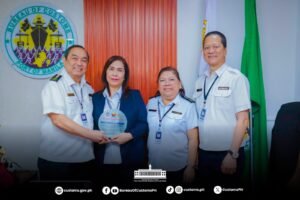
Collector RJ Torralba is steering the Port of Manila’s drive to translate Commissioner Nepomuceno’s reform agenda into concrete accomplishments.
From strengthening transparency in container examinations to intensifying stakeholder consultations, the Port is working to reinforce public confidence in customs administration.
The Port’s Memorandum of Agreement with the Philippine Chamber of Customs Brokers, Inc. (PCCBI) is a significant step toward improving transparency in container examinations. The continuing Port of Manila Customs Industry Consultative and Advisory Council (POM-CICAC) likewise provides a venue for dialogue, coordination, and the resolution of concerns affecting customs operations.
The message is clear: customs administration must be open to scrutiny, responsive to legitimate stakeholders, and uncompromising in protecting public interest.
For Torralba, the real test of leadership is whether reform produces measurable improvements in the way the Port performs its duties.
₱58.121 BILLION! COLLECTION FIGURES PACK A PUNCH!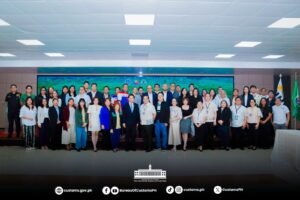
The Port of Manila generated a staggering ₱58.121 billion in revenue from January to August 2026, highlighted by a record-high monthly collection of ₱8.930 billion in July.
That is no small figure in a port where every assessment, every shipment, and every transaction can affect government revenue and the country’s trade performance.
Under Deputy Collector for Assessment Florante Ricarte, the assessment function remains a crucial frontline in ensuring that import transactions are properly evaluated and government revenues are protected.
Assessment is where accuracy matters, compliance counts, and mistakes can carry a heavy price. Every legitimate duty and tax must be accounted for, while procedures must remain consistent with customs laws and regulations.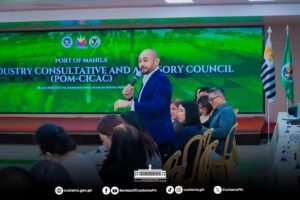
The challenge is to sustain strong revenue performance without sacrificing fairness, due process, or the efficient release of legitimate cargo.
The stakes are enormous: every peso lawfully collected strengthens the government’s capacity to fund public services and national development.
TURIANO ON THE OPERATIONS FRONT: ENFORCEMENT MUST BITE!
Deputy Collector for Operations Atty. Gerard Turiano is among the key officials whose operational responsibilities form part of the Port’s effort to keep cargo movement, enforcement activities, and port operations aligned with the Bureau’s reform agenda.
The figures underscore the importance of vigilance.
From January to August 2026, the Port recorded seizures valued at ₱410.543 million involving violations of the Customs Modernization and Tariff Act and anti-agricultural smuggling laws.
These enforcement results underline the continuing battle against unlawful importation, prohibited goods, and attempts to circumvent customs regulations.
But the fight does not end with a seizure. Proper documentation, lawful enforcement, coordination among concerned agencies, and the disposition of seized goods must all stand up to scrutiny.
The challenge for the Port’s operations team is to keep enforcement firm, procedures lawful, and legitimate trade moving.
No shortcuts. No special treatment. No compromise with violations of the law.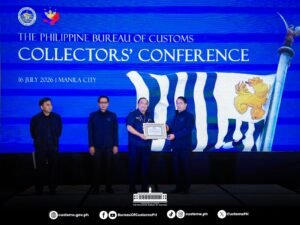
That is the standard a modern Customs administration must pursue.
₱103.567 MILLION FROM AUCTIONS — ACCOUNTABILITY IN ACTION!
The Port also generated ₱103.567 million in auction proceeds from the accountable disposition of seized, forfeited, and abandoned goods during the same eight-month period.
The figure adds another dimension to the Port’s performance: accountability does not stop when goods are seized. Their custody and eventual disposition must also follow applicable laws and procedures.
When properly handled, the disposition of these goods can generate proceeds for the government while reinforcing the principle that customs enforcement must have a lawful and transparent conclusion.
The public deserves to know that government assets and seized goods are handled responsibly, with safeguards against irregularities and abuse.
That is where transparency must be more than a catchphrase—it must be built into every stage of the process.
BARGE TRANSFERS GO DIGITAL — POM BREAKS NEW GROUND!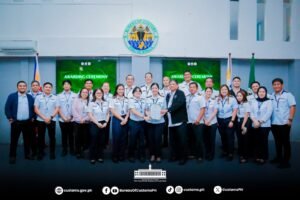
Perhaps one of the Port’s most significant modernization moves is its pioneering integration of barge transfer operations into the Electronic Tracking of Containerized Cargo (E-TRACC) System.
The Port of Manila became the first BOC port to integrate barge transfer operations into the system, enabling GPS-based, real-time monitoring of containerized cargo transported through waterways.
Implemented under Customs Memorandum Order No. 09-2024, the initiative opens additional cargo movement options, supports trade facilitation, and helps ease road congestion through monitored routes linking key port facilities and economic zones.
This is where modernization becomes tangible.
Instead of relying solely on conventional monitoring procedures, electronic tracking strengthens visibility over cargo movements and helps Customs personnel monitor compliance with authorized routes.
For a busy port facing the daily pressures of trade, logistics, and congestion, technology must serve a clear purpose: improve oversight, reduce vulnerabilities, and make legitimate cargo movement more efficient.
The Port also kept yard utilization at 64 percent in July and 66 percent in August 2026, below the 70-percent ideal target cited in its report.
Its continued use of the POM Dashboard to monitor assessment processing times further reflects the importance of data-driven management in identifying bottlenecks and improving efficiency.
Modernization is not simply about installing technology. It is about using that technology to make government operations more accountable and responsive.
PEOPLE POWER: REFORM STARTS WITH THE WORKFORCE!
Behind every collection figure, enforcement operation, and modernization project stands a workforce expected to deliver results under pressure.
The Port continues to support Civil Service Examination review sessions, the Customs Learning and Assessment Skills Series (CLASS), employee-centered activities under the Gender and Development Focal Point System, and recognition programs for retiring and long-serving personnel.
These initiatives reinforce an important truth: institutional reform cannot survive on systems alone. It also requires competent personnel, ethical leadership, continuous learning, and a workplace culture that rewards professionalism.
The weekly Holy Mass gatherings and values formation activities likewise form part of the Port’s efforts to promote ethical public service.
But values must ultimately be reflected in conduct. Integrity must be visible in transactions. Accountability must be evident in decisions. And professionalism must be felt by stakeholders who deal with Customs every day.
NEPOMUCENO’S IAM BOC MOVEMENT: THE PRESSURE IS ON!
Commissioner Ariel F. Nepomuceno’s IAM BOC Movement has placed integrity, accountability, and modernization at the center of the Bureau’s transformation agenda.
The Port of Manila’s reported accomplishments show how that agenda is being pursued at the district level.
Nepomuceno commended Torralba and the Port workforce for translating the reform program into concrete action, emphasizing the importance of stronger accountability, ethical service, and modernized customs operations.
Torralba, for his part, reaffirmed the Port’s commitment to the Commissioner’s reform agenda, stressing that integrity in service, accountability in performance, and modernization must lead to stronger public trust, better trade facilitation, and the protection of government revenue.
The challenge now is consistency.
Revenue performance must be sustained. Enforcement must remain impartial. Assessment must be accurate. Cargo monitoring must be effective. And every modernization initiative must deliver practical benefits to the public and the legitimate trading community.
THE BOTTOM LINE: RESULTS MUST KEEP COMING!
The Port of Manila’s figures are substantial: ₱58.121 billion in revenue, ₱410.543 million in seizures, and ₱103.567 million in auction proceeds from January to August 2026.
These accomplishments provide a strong basis for measuring the Port’s contribution to the Bureau’s reform agenda. Yet the work is far from finished.
For Collector RJ Torralba, Deputy Collector Florante Ricarte, and Deputy Collector Atty. Gerard Turiano, the continuing challenge is to turn these results into sustained institutional performance—without compromising fairness, transparency, and the rule of law.
For Commissioner Nepomuceno, the Port of Manila is another critical proving ground for the IAM BOC Movement.
The message to the entire Customs organization is unmistakable: reform must be seen, accountability must be enforced, and performance must be measured.
Because in the battle to modernize Philippine Customs, big numbers make headlines—but integrity, lawful enforcement, and lasting public trust are what make reform count.