 Dr. Bernie Anabo Jr
When the U.S. State Department released its 2025 Investment Climate Statement, calling out bribery and corruption as barriers to doing business in the Philippines, most agencies might have quietly kept their heads down. But not the Bureau of Customs—not under Commissioner Ariel F. Nepomuceno.
Barely three months into his leadership, Commissioner Nepomuceno has done what few before him dared—he formally reached out to the American Chamber of Commerce of the Philippines (AmCham) and the U.S. Embassy, through the Department of Foreign Affairs, to request a direct dialogue. His message was simple but powerful: the BOC is changing, and it deserves to be heard.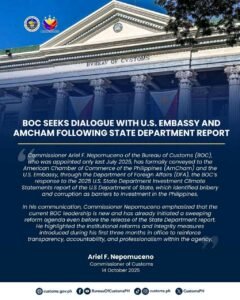
This move was not one of defensiveness, but of confidence and transparency. Nepomuceno made it clear that the current Customs leadership is new, untainted by the baggage of the past, and already implementing a comprehensive reform agenda even before Washington’s report came out.
“The Bureau of Customs acknowledges the concerns raised by our international partners and responds with resolve, not resistance,” the Commissioner said. “We have requested a dialogue with the American Chamber of Commerce and the U.S. Embassy to strengthen cooperation further.”
Those words carry the weight of conviction. Nepomuceno is not merely reacting—he is leading. And he is doing so with both humility and authority, setting the tone for a Bureau that wants to be a partner, not a problem, in advancing the country’s investment climate.
Under his direction, the BOC has already tightened enforcement protocols, halted arbitrary Letters of Authority and Mission Orders, barred conflicts of interest, and reinforced the agency’s “No-Take Policy.” These are not slogans—they are structural changes designed to clean house and restore trust.
Moreover, Nepomuceno’s adoption of technology-driven systems and his reconvening of the Customs Industry Consultative and Advisory Council send a clear message: the Bureau is opening its doors, listening to stakeholders, and inviting transparency in an institution once synonymous with opacity.
Critics may point to history, but Nepomuceno is writing a new chapter—one that aligns squarely with President Ferdinand R. Marcos Jr.’s directive to professionalize government service and eliminate corruption.
And make no mistake: requesting dialogue with the U.S. is not a plea—it is a statement of accountability and confidence. It tells the world that the Philippines, through a reformed Customs Bureau, is ready to engage in honest conversation about its progress, challenges, and commitments.
“Under my leadership,” Nepomuceno vowed, “the Bureau will be a firm, fair, and transparent institution—one that enforces the law without fear or favor, protects legitimate trade, and upholds the integrity of our nation’s borders and economy.”
This is the kind of leadership that rebuilds institutions.
This is the kind of diplomacy that earns respect.
And this is the kind of Commissioner the Bureau of Customs has long needed—a man unafraid to face the world and say: we are changing, and we mean it.