 Bernie Anabo Jr.
NAIA Terminal 3 just became the latest battlefield in the government’s all-out war against drugs.
In a high-stakes interdiction that sent shockwaves through the airport, the Bureau of Customs–NAIA foiled a brazen smuggling attempt involving 4,008 grams of methamphetamine—with a street value of ₱27,254,400—hidden inside the hand-carry baggage of an arriving passenger on February 19, 2026.
The suspect? An Australian national who thought he could slip past Philippine authorities.
He thought wrong.
FOUR KILOS OF SHABU. HAND-CARRY.
This was no small-time courier job. Four kilos of meth—locally known as shabu—packed and concealed inside cabin luggage. That’s millions worth of poison intended to flood communities, destroy families, and bankroll transnational drug syndicates.
But before the shipment could hit the streets, it hit a wall.
That wall was BOC-NAIA, working in tight coordination with the Philippine Drug Enforcement Agency (PDEA) and the NAIA Inter-Agency Drug Task Group (NAIA-IADTG). The operation was swift, precise, and airtight—examination, documentation, seizure, arrest.
No leaks. No excuses. No escape.
The suspect is now facing charges for violating Republic Act No. 9165, the Comprehensive Dangerous Drugs Act of 2002, and is undergoing inquest and prosecution proceedings.
NEPOMUCENO: “WE WILL NOT LET OUR GATEWAYS BE USED.”
At the center of the crackdown is Customs Commissioner Ariel F. Nepomuceno, who has made it crystal clear: Philippine borders are not playgrounds for drug syndicates.
Under the directive of President Ferdinand R. Marcos Jr. to intensify border security, Nepomuceno has doubled down on intelligence-driven operations and inter-agency muscle.
His message to traffickers?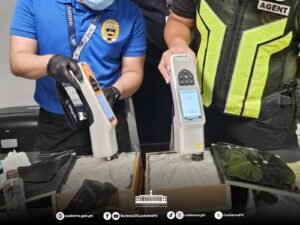
Try us.
Sustained enforcement, tighter coordination, and zero complacency—that’s the marching order. International airports, he stressed, will not be exploited as entry points for narcotics under his watch.
And this latest bust proves that the Bureau is not blinking.
MAPA: “ZERO TOLERANCE. NO SECOND CHANCES.”
On the ground at NAIA, District Collector Atty. Yasmin O. Mapa delivered an equally uncompromising stance.
“NAIA remains a critical gateway, and we treat every attempt to misuse it with the highest level of seriousness,” she emphasized.
Collector Mapa underscored that Customs officers at NAIA are trained to detect even the most sophisticated concealment methods. From profiling to X-ray screening to physical inspection, the Port is on high alert.
Her warning was blunt and direct: those who attempt to smuggle illegal drugs into the country will be intercepted—immediately—and prosecuted to the fullest extent of the law.
No VIP treatment.
No diplomatic smiles.
No special passes.
MESSAGE TO DRUG SYNDICATES: THE GATE IS GUARDED
This ₱27.25-million bust is more than a seizure—it’s a statement.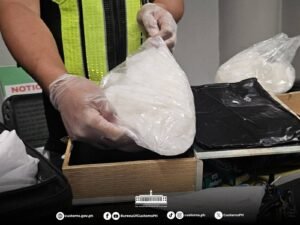
It signals that Philippine authorities are tightening the noose around international trafficking networks attempting to use commercial flights as pipelines for narcotics.
Four kilos of meth off the streets means thousands of lives potentially saved. It means one less shipment funding organized crime. It means the gateway is guarded.
The Bureau of Customs, under Commissioner Nepomuceno, and BOC-NAIA, led by Collector Mapa, have drawn the line at the runway.
And if this latest bust is any indication, anyone trying to cross that line with drugs in their bag better think twice.
Because at NAIA, the scanners are sharp, the coordination is tight—and the handcuffs are ready.