 Bernie Anabo Jr.
For decades, the Bureau of Customs has been haunted by a familiar enemy: smugglers, technical fraudsters, undervaluers, and syndicates that have bled billions of pesos from government coffers.
Many fought them. Some succeeded. Others merely scratched the surface.
But today, a quiet revolution is taking place inside the Bureau—and it may prove to be one of the most consequential reforms in recent Customs history.
The transfer of the Accounts Management Office (AMO) from the Intelligence Group to the Post-Clearance Audit Group (PCAG) is not just another bureaucratic reshuffling.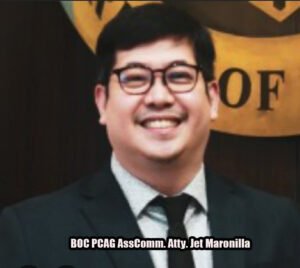
It is a declaration of war.
And leading that offensive is Assistant Commissioner Atty. Vincent “Jet” Maronilla.
For years, Customs intelligence gathered mountains of information on importers, suspicious transactions, and risk indicators.
The problem was simple: intelligence without enforcement is merely information.
Now, that wall has been demolished.
By placing AMO under PCAG, Commissioner Ariel Nepomuceno has effectively armed the Bureau’s audit and compliance forces with the very intelligence they need to hunt down revenue cheats.
At the center of this transformation stands Maronilla, one of the Bureau’s most respected reform-oriented officials.
Under his leadership, PCAG is no longer just an audit office. It is becoming a powerful compliance machine capable of converting raw data into enforcement actions, risk profiles into investigations, and suspicious declarations into collectible revenues.
This is where the battle against customs fraud is increasingly being fought—not at the port gates alone, but in the documents, records, financial trails, and post-entry audits that expose those who thought they had already escaped scrutiny.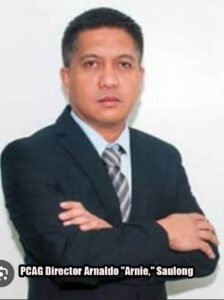
Standing beside Maronilla is PCAG Director Arnaldo Saulong, a seasoned customs officer whose extensive operational experience gives the reform its practical muscle.
Saulong understands that successful enforcement is not about headline-grabbing raids alone.
It is about building airtight cases, pursuing violations relentlessly, and ensuring that those who shortchange the government are held accountable.
His role in integrating audit operations with risk-based intelligence will be critical in translating policy into measurable results.
Then there is AMO Chief Atty. Jonathan Mengullo, whose office serves as the Bureau’s nerve center for importer profiling and risk analysis.
Mengullo’s team maintains the data that identifies patterns, flags anomalies, and separates legitimate traders from potential violators.
In many ways, AMO is Customs’ radar system.
Without accurate profiling, enforcement is blind.
Without reliable intelligence, audits become guesswork.
Under the new structure, Mengullo’s intelligence capabilities are no longer operating in isolation.
They are directly connected to the audit machinery of PCAG, creating a powerful enforcement chain that can detect, investigate, and pursue customs fraud with greater precision.
The result is a potentially devastating blow against undervaluation, misdeclaration, technical smuggling, and other schemes that have long deprived the government of billions in revenues.
More importantly, this reform sends a chilling message to habitual violators:
The days of hiding behind paperwork loopholes may be coming to an end.
Commissioner Ariel Nepomuceno deserves credit for recognizing that modern Customs administration is no longer about random inspections and reactive enforcement.
The future belongs to data-driven governance, intelligence-led compliance, and strategic auditing.
The Maronilla-Saulong-Mengullo team now sits at the heart of that vision.
Their challenge is enormous.
The resistance from entrenched interests will be fierce.
The pressure will be relentless.
But if this integration succeeds, it could become one of the defining reforms of the Nepomuceno administration.
Because in the end, the most dangerous weapon against smuggling is not merely intelligence.
It is intelligence that leads to accountability.
And that weapon is now firmly in the hands of PCAG.