 Bernie Anabo Jr.
From Taxpayer Portal to AI “Terry,” Commissioner Mendoza pushes a tougher, smarter and more taxpayer-centered BIR
The Bureau of Internal Revenue is no longer talking about reform in whispers. It is putting reform on the table—and BIR Commissioner Atty. Charlito Martin R. Mendoza is putting his name and leadership behind it.
At the PICPA Metro Manila Region Tax Conference 2026, Mendoza delivered a blunt message: the Philippine tax system has to move beyond mere compliance and into modernization, accountability, technology and partnership.
And the centerpiece of that push is DARES.
Speaking before accountants, tax practitioners, business executives, finance professionals and government representatives, Mendoza laid out a reform agenda that reaches from the taxpayer’s computer screen to the Bureau’s enforcement machinery.
THE DIGITAL BIR IS COMING
One of the major weapons in Mendoza’s reform arsenal is the Taxpayer Portal, now being rolled out to the Large Taxpayers Service, with regional implementation targeted for October.
The message is unmistakable: less friction, more digital service and greater accountability.
Mendoza also highlighted a new audit program designed to incorporate stakeholder feedback while strengthening accountability mechanisms.
Then comes the Electronic Invoicing System (EIS)—a reform the Commissioner says needs to get off the ground.
“Kailangan talagang ma-implement na natin ito and we really need your help and assistance on this,” Mendoza told stakeholders.
That was not simply a request for cooperation.
It was a challenge.
295 CASES. ₱34-BILLION TAX EXPOSURE.
While Mendoza talks modernization, the enforcement side of the BIR remains firmly in motion.
Through the Run After Tax Evaders (RATE) Program, the Bureau reported that 295 tax-evasion cases were filed from January to July, representing approximately ₱34 billion in tax exposure.
That figure sends a clear signal:
Digital transformation does not mean soft enforcement.
Instead, the Mendoza formula appears to be assistance first, compliance next—and enforcement when necessary.
The Commissioner described the approach as:
“Assistance First to Comply, Enforcement Only When Necessary.”
For legitimate taxpayers, that means assistance should come before confrontation.
For those who deliberately evade their obligations, however, the RATE machinery remains available.
MENDOZA’S MESSAGE TO TAXPAYERS: FIX IT—BEFORE IT GETS UGLY
Mendoza also called attention to the One-Time Abatement Program for Micro Taxpayers, urging accountants and tax professionals to help qualified entrepreneurs understand and avail themselves of the program.
For small businesses carrying old tax liabilities, the initiative is being positioned as a pathway toward settling long-standing obligations and returning to compliance.
The message is simple:
Come forward. Settle. Comply. Move forward.
ENTER “TERRY” — THE BIR’S AI TAX RESEARCH WEAPON
But perhaps the most eye-catching element of Mendoza’s presentation was not another enforcement program.
It was Terry.
The BIR’s AI-powered tax research assistant is being developed to cross-reference, retrieve and analyze BIR revenue issuances dating back to 1905.
Think about that.
More than a century of tax issuances—potentially searchable and analyzable through an artificial-intelligence system.
Terry will initially undergo internal stress testing, with the possibility of eventually being made accessible to external stakeholders.
If successfully implemented, this could dramatically change how tax professionals and BIR personnel research historical revenue issuances.
And Mendoza is also looking beyond traditional government technology.
The BIR has partnered with Ateneo de Manila University on data-science initiatives, signaling an effort to bring stronger analytical capabilities into tax administration.
NO MORE OLD-SCHOOL TAX ADMINISTRATION?
That is the larger question hanging over Mendoza’s DARES agenda.
Can a tax agency built around massive amounts of paperwork, rules, records and transactions become genuinely digital?
Can technology make compliance easier while making enforcement more targeted?
Can taxpayer service and revenue collection advance together?
Mendoza’s answer appears to be yes—but only if the BIR and its stakeholders work together.
His message at the PICPA conference was unmistakable:
“Beyond compliance is partnership—our partnership with you, our stakeholders.”
And then came the bigger promise:
“The BIR we are building now is modern, accountable, taxpayer-centered, and capable of delivering real impact.”
THE MENDOZA TEST
This is where the real test begins.
Plans are easy.
Programs can be announced.
Technology can be purchased.
Systems can be launched.
But results are what taxpayers will ultimately see.
The success of DARES will depend on whether the Taxpayer Portal actually makes transactions easier, whether the new audit program delivers consistency and accountability, whether EIS becomes operational and workable, and whether artificial intelligence such as Terry produces useful, reliable results.
For Commissioner Atty. Charlito Martin R. Mendoza, the challenge is enormous.
But so is the opportunity.
He is attempting to push the BIR toward a model where technology strengthens enforcement, data improves decision-making, taxpayer service becomes more accessible, and compliance becomes less burdensome for legitimate businesses.
That is an ambitious agenda.
And now that Mendoza has placed it squarely before the country’s tax professionals, accountants and business community, the spotlight is on the BIR.
No excuses. No endless waiting. No reform on paper alone.
The taxpayers want results.
The business sector wants predictability.
The government needs revenue.
And Mendoza’s DARES agenda now faces the only question that ultimately matters:
CAN THE BIR TURN THE REFORM BLUEPRINT INTO REAL, VISIBLE CHANGE?
The clock is ticking.
INSIGHT
By: Dr. Bernie R. Anabo Jr.
TORRALBA’S HARD LINE: ₱1.65-MILLION LOADS GO TO THE GRAVEYARD!
BOC–PORT OF MANILA CRUSHES 7 CONTAINERS IN NO-RETURN-TO-MARKET DRIVE
Seven containers. More than ₱1.650 million worth of seized and forfeited goods. And not a single item was allowed another shot at the market.
That is the message coming out of the Bureau of Customs–Port of Manila (BOC-POM) under District Collector Rizalino Jose “R.J.” C. Torralba.
The Port of Manila has completed the condemnation of seven containers packed with various seized and forfeited commodities, putting a definitive end to their possible unauthorized circulation.
The operation, conducted through the Auction and Cargo Disposal Division (ACDD) in Biñan, Laguna, lasted 10 days and concluded on September 15.
This was not simply a disposal exercise.
It was a hard stop.
Among the condemned goods were grocery products, deteriorated LED lighting fixtures, furniture, medical supplies, mattresses, toothbrushes, household goods and personal effects.
Some had been sitting under customs custody for years, covered by Warrants of Seizure and Detention (WSDs) issued in various years.
Now, they are gone.
NO SECOND CHANCE
Under Order of Condemnation No. 01-2026, the goods were ordered destroyed/disposed of in accordance with applicable customs rules and procedures.
The seizures and forfeitures involved violations cited under Section 1400 in relation to Section 1113 of the Customs Modernization and Tariff Act (CMTA), as well as Republic Act No. 8293, or the Intellectual Property Code of the Philippines.
The significance is clear:
Goods that have been legally forfeited in favor of the government cannot simply be allowed to re-enter commerce through the back door.
That is where Torralba’s leadership at the Port of Manila comes into sharp focus.
TORRALBA: NO ROOM FOR SHORTCUTS
Under Collector R.J. Torralba, the condemnation operation demonstrates that enforcement does not end when Customs intercepts questionable shipments.
It continues until the forfeited goods are lawfully and properly disposed of.
That final step matters.
A seizure without proper disposition can leave opportunities for goods to remain in storage, become a logistical burden, or potentially find their way into unauthorized channels.
The Port’s latest operation sends the opposite signal:
SEIZED MEANS SEIZED. FORFEITED MEANS FORFEITED. AND CONDEMNED MEANS OUT OF THE MARKET.
₱1.65 MILLION — WIPED OFF THE SUPPLY CHAIN
The value involved—more than ₱1.650 million—may represent different commodities, but the enforcement message is one and the same.
The government will not allow forfeited shipments to become somebody else’s merchandise.
From deteriorated lighting fixtures to household goods, medical supplies and other commodities, the items were subjected to the prescribed condemnation process rather than left hanging indefinitely.
This is precisely where the work of the Port’s disposal personnel becomes part of the broader anti-smuggling campaign.
THE TORRALBA STANDARD
The operation was conducted pursuant to the directives of Collector Torralba, reinforcing the Port of Manila’s stated commitment to lawful, transparent and accountable disposition of seized and forfeited goods.
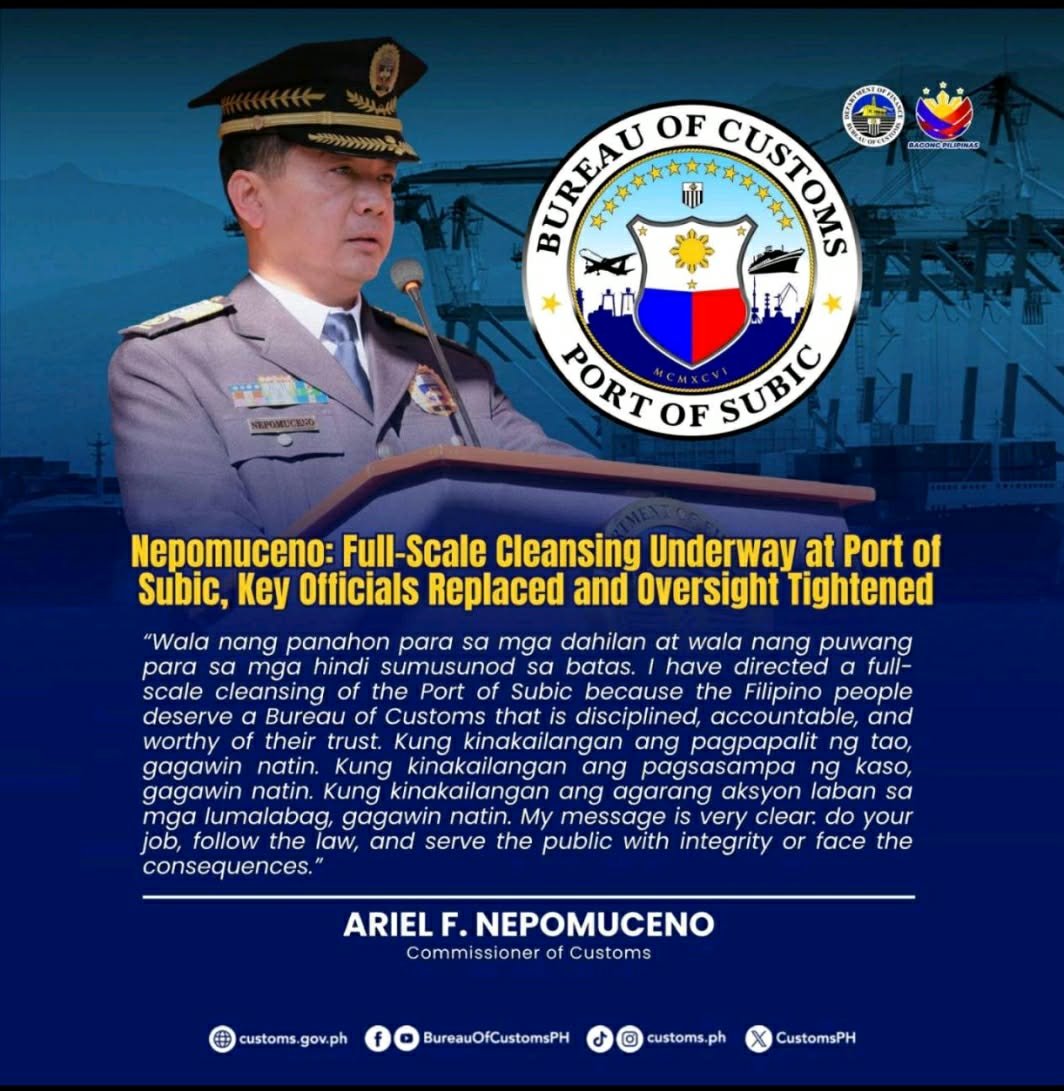
And under Commissioner Ariel F. Nepomuceno, the BOC continues to emphasize enforcement, border protection and the fight against smuggling.
But at the port level, implementation is where policies are tested.
In Manila, Torralba’s name is now attached to another message:
NO SHORTCUTS. NO BACK DOORS. NO FREE PASS.
Seven containers have been condemned.
More than ₱1.65 million worth of goods have been removed from the possibility of unauthorized circulation.
And the Port of Manila has once again demonstrated that the battle against illicit trade does not stop at the seizure point.
IT ENDS WHEN THE FORFEITED GOODS ARE FINALLY OUT OF THE MARKET.
That is the Torralba line—and this time, seven containers crossed it.
Compose