
 Bernie Anabo Jr.
The message from the Bureau of Customs–Port of Batangas is getting louder:
Business must move. Customs must deliver. And compliance cannot be compromised.
That direction was underscored when District Collector Carmelita “Mimel” M. Talusan led a meeting with representatives of U-Freight and JMSJ Customs Brokerage and Logistics to tackle customs concerns involving the importation of BYD electric and hybrid vehicles through the Port of Batangas.
This was not simply another meeting.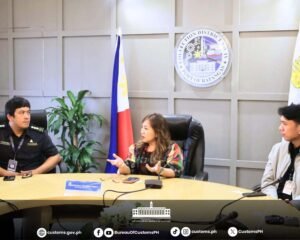
It was a working engagement focused on how customs procedures can keep pace with a rapidly changing automotive industry—without sacrificing transparency, accountability and compliance.
Representing U-Freight were Rowena Relativo, Marife Echavia and Marville Isla, while Sarah Jacinto and Charli Villavicencio represented JMSJ Customs Brokerage and Logistics.
At the center of the discussion: how to make legitimate vehicle imports move efficiently through the customs system while ensuring that all requirements are properly observed.
And this is where Collector Mimel Talusan is putting her stamp on the Port of Batangas.
MIMEL: FACILITATE TRADE, BUT FOLLOW THE RULES!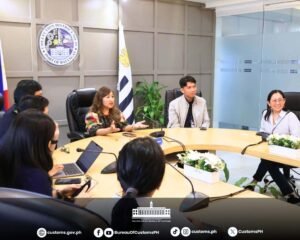
Electric and hybrid vehicles are no longer merely a niche in the automotive market.
They represent a growing segment of the country’s evolving mobility landscape—and ports must be prepared to handle the changing demands of importers, logistics companies and consumers.
For Talusan, the challenge is clear:
Facilitate legitimate trade. Strengthen coordination. Protect government revenue. Enforce customs laws.
No shortcuts.
No confusion.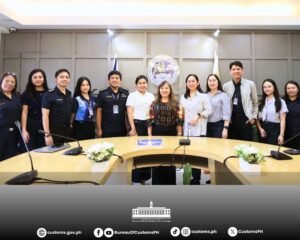
No unnecessary barriers.
The engagement with the private sector demonstrates the importance of direct dialogue in resolving trade-related concerns before they become operational bottlenecks.
That is precisely the kind of frontline coordination expected from a major gateway such as the Port of Batangas.
BATANGAS: A GATEWAY FOR THE NEW AUTOMOTIVE ERA
With BYD’s electric and hybrid vehicles entering through the port, Batangas is increasingly positioned at the intersection of traditional automotive logistics and the country’s emerging electric-mobility market.
That brings responsibility.
A major automotive gateway needs customs operations that are responsive, transparent and predictable—while remaining firmly anchored on the law.
Under Talusan’s leadership, the Port of Batangas is emphasizing engagement with legitimate industry stakeholders as part of its continuing effort to improve service delivery.
The formula is straightforward:
Industry talks. Customs listens. Problems are identified. Processes are clarified. Compliance remains non-negotiable.
MIMEL TALUSAN ON THE FRONT LINE
The meeting also reflects a broader direction under BOC Commissioner Ariel F. Nepomuceno, whose programs emphasize modernization, integrity, accountability and more responsive customs service.
At the port level, however, policies only become meaningful when officials translate them into actual operations.
That puts district collectors on the front line.
And in Batangas, Talusan is taking that frontline role seriously.
Her engagement with U-Freight and JMSJ shows that customs administration is not simply about inspecting cargo and collecting duties.
It is also about understanding legitimate business concerns, coordinating with stakeholders and finding ways to make lawful trade move more efficiently.
Because in today’s global economy, every unnecessary delay has a cost.
But so does weak enforcement.
The challenge is finding the balance—and ensuring that both sides of the equation are protected.
THE BOTTOM LINE
The BYD engagement sends a clear signal:
Port of Batangas wants trade moving—but moving correctly.
Under Collector Carmelita “Mimel” Talusan, the port is opening the lines of communication with the private sector while keeping the focus on efficiency, transparency and compliance.
For importers and logistics players, the message is equally clear:
Come to the table. Raise legitimate concerns. Work with Customs. Follow the rules.
That is how a modern port should operate.
And if Batangas continues on this track, the port will not merely serve as a gateway for vehicles.
It can become a gateway for a faster, cleaner and more responsive customs environment—one legitimate shipment at a time.