 Dr. Bernie Anabo Jr
MANILA — Even before the release of the 2025 U.S. State Department’s Investment Climate Statements report that flagged bribery and corruption as investment barriers in the Philippines, the Bureau of Customs (BOC) had already taken concrete steps to clean up its ranks and restore trust in its operations.
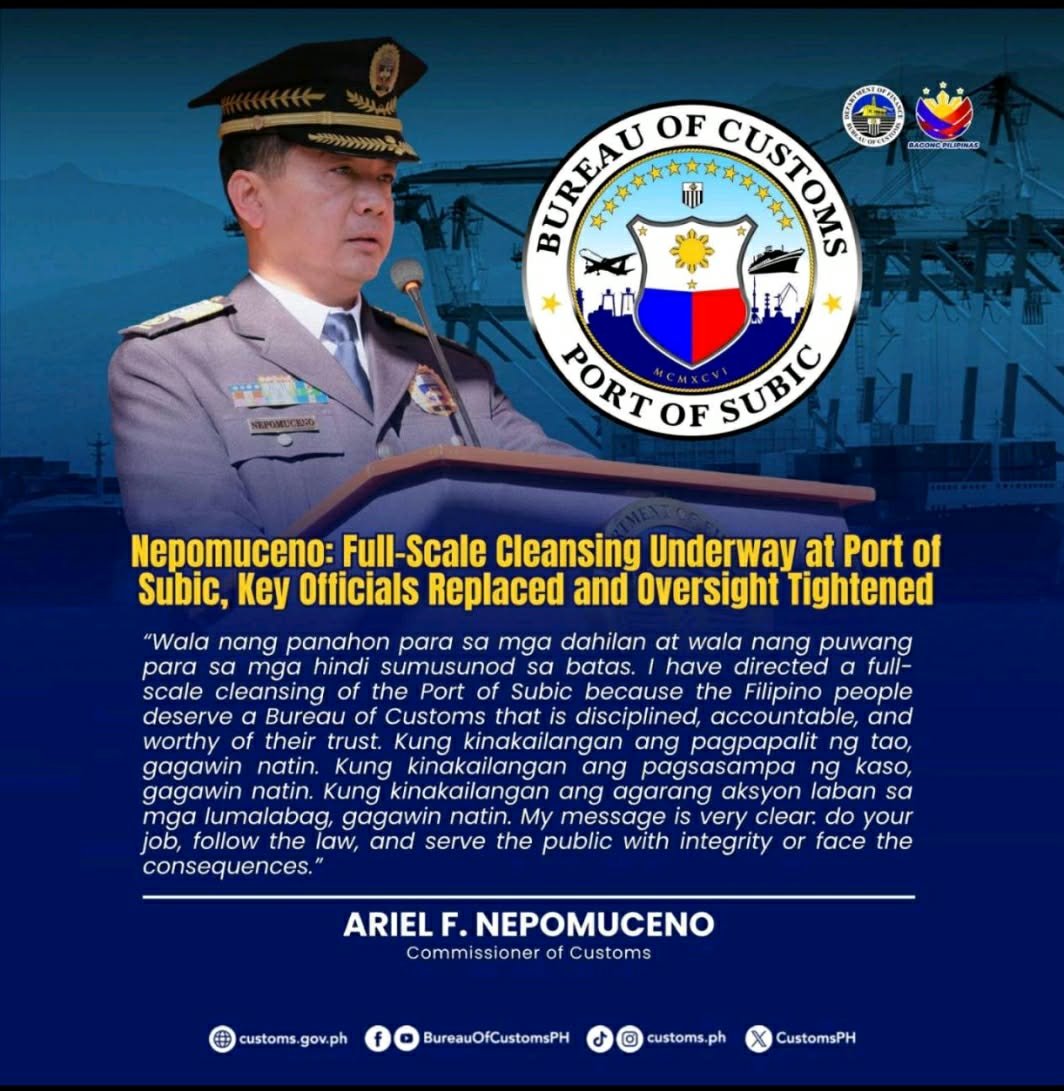
At the forefront of these sweeping reforms is Commissioner Ariel F. Nepomuceno, whose first 100 days in office have been marked by bold institutional changes aimed squarely at eradicating corruption and fostering integrity within the agency.
***
“No Take” Policy Sets the Tone
Commissioner Nepomuceno wasted no time setting the tone for his administration. One of his earliest directives was the implementation of a strict “No Take” policy, which categorically prohibits any form of bribery or unlawful monetary transactions within the BOC.
The order applies to all levels of personnel, with violators facing immediate disciplinary action and possible criminal prosecution in coordination with law enforcement agencies.
“This is a zero-tolerance administration,” a senior BOC official noted. “Commissioner Nepomuceno made it clear from day one that there is no room for compromise when it comes to integrity.”
***
Conflict of Interest Ban: A Landmark Move
In a groundbreaking measure to eliminate potential conflicts of interest, Nepomuceno signed a memorandum on July 10, 2025, banning all BOC officials and employees from maintaining any business or financial interests in customs brokerage operations.
Personnel are also required to disclose any familial ties to brokerage firms—an unprecedented move that underscores Nepomuceno’s commitment to transparency and impartiality in customs transactions.
To further bolster this safeguard, the Commissioner has mandated the submission of affidavits detailing all past or present connections to customs-related businesses, ensuring that no hidden relationships can compromise the Bureau’s integrity.
***
Balancing Enforcement with Fairness
Responding to stakeholder complaints about excessive enforcement actions, Nepomuceno ordered the suspension of unserved Letters of Authority (LOA) and Mission Orders (MO).
This suspension, he explained, allows the Bureau to review and recalibrate its enforcement protocols to ensure that legitimate businesses are not unnecessarily disrupted.
“Our goal is to maintain the integrity of customs enforcement while respecting due process,” Commissioner Nepomuceno said. “We want enforcement to be fair, targeted, and data-driven.”
***
Strengthening Collaboration with Investors
Recognizing the importance of trust and dialogue, Commissioner Nepomuceno has also prioritized collaboration with international partners and business chambers.
Under his leadership, the BOC will continue to strengthen the Customs Industry and Advisory Council (CICAC)—a consultative platform that allows the private sector and foreign investors to engage directly with the Bureau.
Through CICAC, Nepomuceno envisions a more transparent and responsive customs administration, where policies are discussed openly and solutions are co-created to improve trade facilitation.
***
Digital Transformation as Long-Term Solution
While the anti-corruption drive has taken center stage, Commissioner Nepomuceno’s long-term vision is anchored in full digitalization and automation of customs processes.
By minimizing human discretion in transactions, the Bureau aims to remove systemic vulnerabilities that have historically enabled corruption.
“Digitalization is not just about efficiency,” Nepomuceno explained. “It’s about building a system that makes corruption impossible.”
***
A Commissioner Committed to Clean Governance
For Commissioner Ariel F. Nepomuceno, these reforms are not reactions to foreign criticism—they are proactive measures driven by his personal and institutional commitment to good governance.
“The reforms we introduced within my first 100 days were not reactionary,” Nepomuceno said. “They were proactive measures rooted in our commitment to clean governance. These measures directly respond to the very issues highlighted in the U.S. State Department report, and we will continue pushing forward with both short and long-term solutions.”
***
A Call for Public Vigilance
The Bureau continues to encourage stakeholders and the public to report any irregularities or corrupt practices. Complaints may be filed through complaint@customs.gov.ph or the Office of the Commissioner at boc.ocom@customs.gov.ph.
All reports are treated with strict confidentiality and investigated thoroughly.
Under Commissioner Ariel F. Nepomuceno’s stewardship, the Bureau of Customs stands firm on its mission to transform itself into a model of integrity, professionalism, and transparency—one that protects investors, promotes fair trade, and upholds public trust.