 Dr. Bernie Anabo Jr
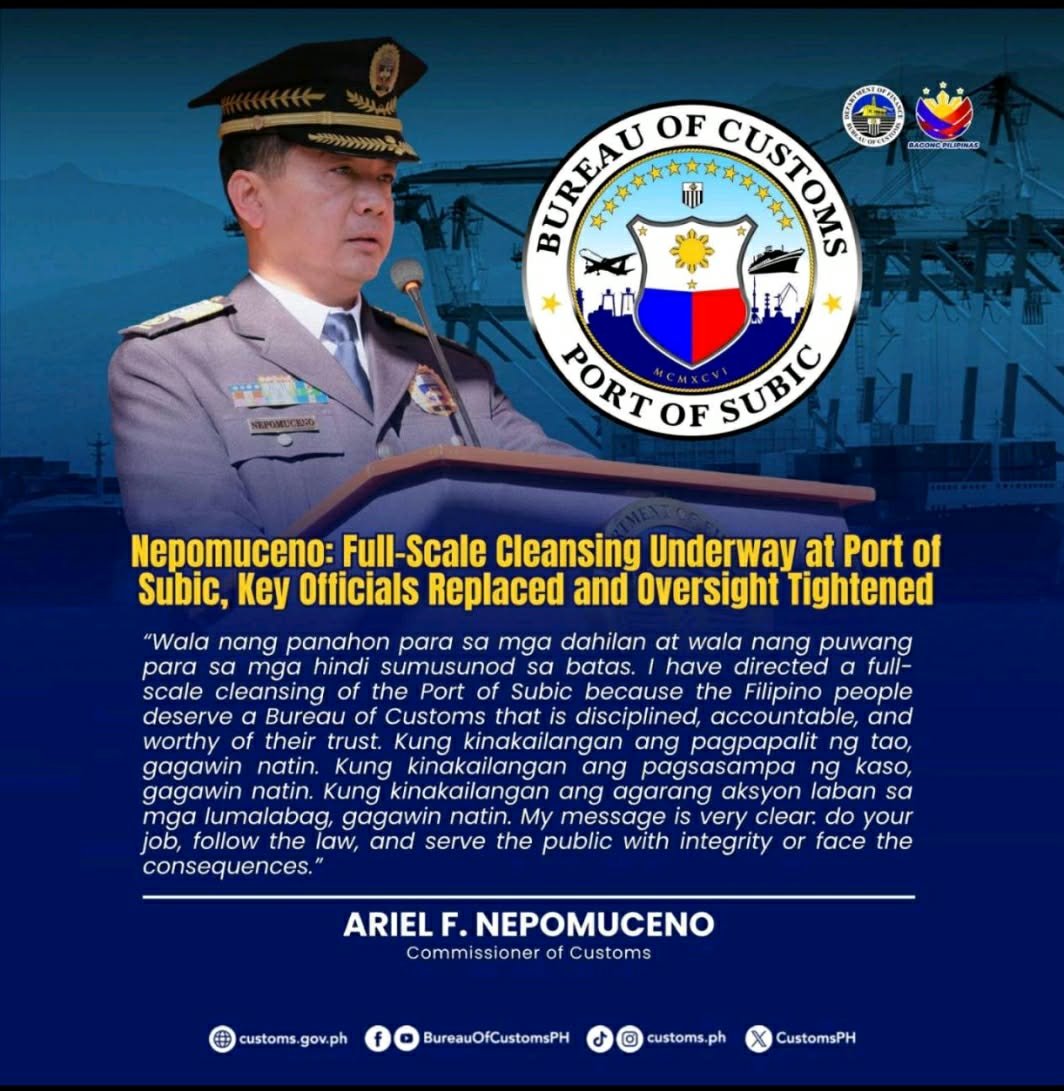
In a bureaucracy long weighed down by red tape and old habits, Commissioner Ariel F. Nepomuceno stands out as a man on a mission — a reformist who doesn’t just talk about change but builds the systems to make it stick.
When Nepomuceno says that “digitalization is the number one solution” to fight smuggling and corruption, he isn’t merely repeating a buzzword. He’s calling for nothing less than a total transformation of how the Bureau of Customs (BOC) does business — replacing opacity with transparency, and discretion with automation.
And make no mistake: in a country where billions are lost to smuggling and backdoor deals, this is not a technical upgrade — it’s a moral crusade.
⸻
At the Supply Chain Security Management Summit 2025, Nepomuceno was in his element — sharp, direct, and determined.
“The BOC, as the main gateway of imports and exports, is a vital component of the entire supply chain both in and out of the country — we play a major role,” he reminded the audience.
For years, the Customs agency has been branded a “problem agency,” often cited for inefficiency and irregularities. But under Nepomuceno, that narrative is changing. His administration has been quietly — but decisively — rebuilding trust, modernizing systems, and drawing a hard line against the syndicates that bleed the economy dry.
And he’s absolutely right to call smuggling what it truly is: a national threat.
“Smuggling directly undermines our industries, workers, and consumers. It distorts fair competition and hinders industrial growth,” Nepomuceno warned.
Those are not empty words. Every shipment that slips through unpaid is money stolen from Filipino taxpayers — funds that could have gone to classrooms, hospitals, and roads. Nepomuceno’s digital push is about closing those leaks once and for all.
⸻
His roadmap for reform is ambitious yet achievable: end-to-end digitalization of import submissions, assessments, and release processes; expanded use of scanning technologies; and 24/7 CCTV monitoring. Within the next 18 months, he envisions a Customs service where every transaction is traceable, accountable, and tamper-proof.
This isn’t just modernization — it’s institutional armor against corruption.
At the same summit, Supply Chain Security Management Society of the Philippines (SCSMSP) President Julius Badillo underscored how global supply chains face new risks — from geopolitical tensions to cyberattacks. He’s right. The world is changing fast, and logistics is no longer just about moving goods; it’s about securing nations.
That’s why Nepomuceno’s digital revolution could not have come at a better time. By reinforcing supply chain security through technology, he is not only improving efficiency but fortifying national resilience.
⸻
In a government often slow to adapt, Commissioner Ariel F. Nepomuceno has emerged as a rare kind of leader — one who understands that real reform begins with systems, not slogans. His digitalization drive is proof that when leadership meets vision, even the most entrenched institutions can be reborn.
If he succeeds — and the momentum suggests he will — the Bureau of Customs will no longer be seen as a symbol of inefficiency and corruption, but as a model of integrity and modernization.
And that transformation, when it happens, will bear one name at its foundation:
Ariel F. Nepomuceno.